Deep Backward Point

Blog against the machine.

Category: Link List

Choosing to Lose

Kartikeya at A Cricketing View analyzes the possibility of a team choosing a tactical defeat in the remaining four games:

In this post, I contemplate a few tactical defeats . A tactical defeat is one in which a team which has a realistic chance of winning, chooses to lose a game by resting key players, or simply by experimenting with batting orders and bowling orders, and letting the other side win in the interest of their position in the tournament. Australia, Pakistan, India, South Africa and West Indies all have this opportunity. [..]

Tactical defeats are unlikely to be of benefit to any side over the remaining three significant games.

Baazigar

Haar kar jeetne wale ko Baazigar kehte hain. (Loosely translated, the one who can lose to win is called a gambler.)


Even though he makes a thorough analysis, he’s wrong. There is one team that can strategically benefit from a defeat– India. They will know the result of all other matches and can choose who to face based on a win or defeat.

Kartikeya is also trying to put together the top team compiled from players at the World Cup based on voting– go vote!

Look How Far We’ve Come

The 5th Test: South Africa v England at Durban, Mar 3-14, 1939:

The “Timeless Test” [was] 10 days long and finally called off because the Englishmen had to catch the boat home. At a rate of 2 runs every 6 balls, they scored over 1800 runs in 10 days.

Sounds like the current World Cup. Except no one has a boat to catch, so it just keeps going…

Unbowlable

Steven Lynch digs up an interesting bit of trivia about batsmen who could not be out bowled:

The rather unlikely name at the top of this list is Courtney Browne, the recent West Indies wicketkeeper who has just been named as a selector. He had 30 innings in Tests, six of them not out, and was never bowled. [..] Pakistan’s Rashid Latif, a wicketkeeper like Browne, had 57 innings and was only bowled once.

I wonder if wicketkeepers are less liable to be bowled, perhaps because they are trained to call the play early. This would mean they know what kind of ball was coming, but not necessarily how to play it.

Anything You Can Do, I Can Do Worse

When associates play each other, it can either produce Ireland v. Bangladesh style hard-fought matches.

Or it can produce a comedy of errors, where each races to the bottom.

When Kenya faced Canada earlier this week, Gunasekara and Ouma found themselves in such a race. Here’s the text from Cricinfo’s live commentary, when Gunasekara got out to a wide ball:

This is Bizarroworld. Ruvindu might be out stumped. Shambles from Ruvindu. Shambles from Ouma. Shambles all round. Stupidity, says Ian Chappell. It slips down the leg side. Ruvindu misses the flick. And looks back. He can’t see the ball. He thinks it has trickled away to fine leg. Ouma, cunningly, hid the ball in his left glove. Once Ruvindu strayed out of the crease, Ouma looked to flick the bails off. And missed! He then flicked again. This time he hits the stumps. Ruvindu is still not in! Haven’t seen something so bizarre from a batsmen since Inzamam tumbled onto his stumps, attempting to sweep Panesar.


Gunasekara v. Ouma

Gunasekara v. Ouma


India’s Harbhajan Problem

Sharda Ugra writes what I was going to, but better:

In the last 12 months, [..]  Harbhajan has nine wickets with an economy rate of 4.30, but an average and strike rate that has gone through the floor of his career figures.

At the World Cup so far, it’s two scalps in four games, with an economy rate of 4.07. Were his role just to contain, in this age of heavy bats, small grounds and Twenty20 attitudes, the economy rate could be something he could boast about. For a strike bowler not to be striking, though, is an indication that something is blunted.

Dhoni’s argument is that the batsmen have been content with seeing him off, and then taking on Yuvraj. Which is why Harbhajan is economical, and Yuvraj gets the wickets.

It’s a sound argument, and one that Sangakkara may be trying to make with respect to Muralitharan as well. And as long as India is winning, the argument will stand unchallenged.

As long as India is winning.

What if everyone could compete for the Ashes?

Nick Barlow asks (and answers) a fascinating question:

A thought struck me as I was looking at the Cricinfo archive yesterday – what if the Ashes hadn’t stayed as purely England vs Australia series, but – when other countries started playing Test cricket – had been seen as an accolade everyone could play for?

He then proceeds to track this “alternate” Ashes from 1891 to 2011, when India retain the Ashes by drawing the series against South Africa.

Not a bad idea for a a Test Championship– you could always have a reigning heavyweight champion of Test cricket, with contenders clamoring to knock them down.

Of course, in Barlow’s “alternate” Ashes, Zimbabwe held the Ashes from 1998/99 to 99/00 by beating India at home.

Pakistan’s Weakest Link

Can a team with such a poor opening pair be contenders in the World Cup? Since the series against South Africa last year, here is the run of opening partnerships:

26, 8, 12, 6, 82, 7, 31*, 2, 43, 20, 14, 11, 28, 16, 5

Of those, the current pair of Messrs. Shehzad and Hafeez account for: 31*, 2, 43, 20, 14, 11, 28, 16, 5

Shehzad has a career ODI average of 27.50. Barring his one (exceptional) century, his average is 20.0 for his remaining innings. But he’s young, he’s only played 13 matches. Hafeez, on the other hand, has an average of 22.22 after 68 matches. That is untenable.

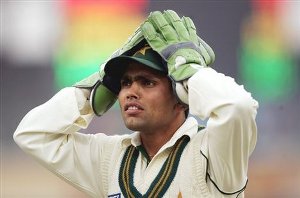
Today, however, their weakest link was Kamran Akmal behind the stumps.


Kamran Akmal: Oh no, not again


Unbeaten

India and Australia remain the only two unbeaten teams in the World Cup so far. And it looks like it will stay that way until Saturday at least.

The difference is that Australia hasn’t been tested yet.

Cricket and Baseball Meet at the Baseball Hall of Fame

Comparison between baseball and cricket playin...

Image via Wikipedia

This year, the Baseball Hall of Fame will host an exhibition on cricket and its common roots with baseball. It opens April 16:

On Sunday, April 17, special programs will feature the Haverford College varsity cricket team – the only one of its kind in the United States – in a variety of public demonstrations and presentations. Plans and programs are still in the development stages for the Hall of Fame’s Cricket Weekend, June 3-5, with additional details to be announced soon.

Highlights include equipment used and worn by “Derek Jeter and Andrew Flintoff, Bengie Molina and Adam Gilchrist, Kumar Sangakkara, Paul Collingwood, Robin Wallace and Charlotte Edwards and Shahid Afridi”. That’s a lot of ands.

The Part-Time Cricketer

Andy Bull writes about the nine-to-five heroes of cricket:

[Seren] Waters [..]  is also just a 20-year-old university student, trying to keep up with a degree course in human geography at Durham in between his innings. [..] Bagai was working 14-hour days as an investment banker for UBS in the city of London. Mudassar Bukhari, who opened the bowling for the Netherlands against England, manages a branch of Burger King in The Hague. Bernard Loots, who finished that innings off, is an accountant for a mining firm.

Living the dream.