Finally, a Test Match
Good morning. At long last, we have a test match.
Personally, I’m interested to see how Bishoo, Rampaul and Simmons fair in the longer game. That will tell us a lot about the future of West Indies cricket.
Good morning. At long last, we have a test match.
Personally, I’m interested to see how Bishoo, Rampaul and Simmons fair in the longer game. That will tell us a lot about the future of West Indies cricket.
After Afridi hinted at trouble between himself and Waqar, rumors began that he would not be the ODI captain on the next tour.
If so, they better start looking for #15. Perhaps Pakistan is ripe for the Buchanan’s multiple captains theory!
Andy Zaltzman is back blogging after a month of cricket detoxification:
In an effort to make the pre-Twenty20 era of cricket retrospectively more exciting, the IPL is being officially backdated. The 1976 IPL has been won by the now defunct Visakhapatnam Visigoths, led by Indian Test legend Gundappa Viswanath and part-owned by legendary film director Satyajit Ray and Scottish pop stars the Bay City Rollers. In a tense final in Madras, they defeated the Delhi Daredevils, for whom Geoff Boycott scored an undefeated 23 off 65 balls as his team narrowly failed to chase down the Visigoths’ total of 93 for 4, an imposing total for the time. The losing semi-finalists were the Punjab Pranksters and the Chennai Benevolent Dictators, later rebranded as the Super Kings.

English Cricket Enters an Era of Better Hair
While the world worries about a three captain strategy, what worried me even more was the unceremonious limited overs retirement of Andrew Strauss.
As an India fan, this has been especially perplexing. A few weeks ago, Strauss played the 2nd-most devastating knock of the World Cup, after Taylor’s decimation of Pakistan. And now he retires.
While his 2011 hasn’t been great, 2010 was the best year of his career. In 14 innings, he scored at an average of almost 58, a strike rate near 100 with two 100s and eight 50s. In 2010, he had more 50s, more 100s, more 4s, more 6s, a higher average, a higher strike rate and more runs than any other year in his career.
It’s not as though England are having a terrific ODI run, where they can afford to lose their top performer.
∞
Alastair Cook is a fine batsman, made the cover of Wisden, has great hair and went to the right schools but– it’s been said a billion times– but why would you name an ODI captain who couldn’t even make the 15 of your World Cup squad? Pietersen, Broad and Shahzad were sent back home injured from the World Cup, and even then, Cook was not invited, which means effectively he is not in the top 18 picks for the England ODI team.
At least he won’t replace someone who actually deserved to be in the squad on cricketing merit. He’ll replacing the retiring Strauss.
Related articles
Tariq Engineer reports for Cricinfo:
[A] cumulative total of 146.4 million viewers have watched all the games so far, a number that exceeds the 143.7 million that saw the entire 2010 season (60 games). This suggests that while the IPL continues to attract new fans, they are watching each game for shorter periods.
Two reasons come to mind:
The Duncan Fletcher era is upon us. The Gary Kirsten era in Indian cricket has been quite something to watch. Especially when coupled with Mahendra Singh Dhoni. Here are some highlights, as I’ve been combing through the statistics of the past few years:
Test record:
One Day record:
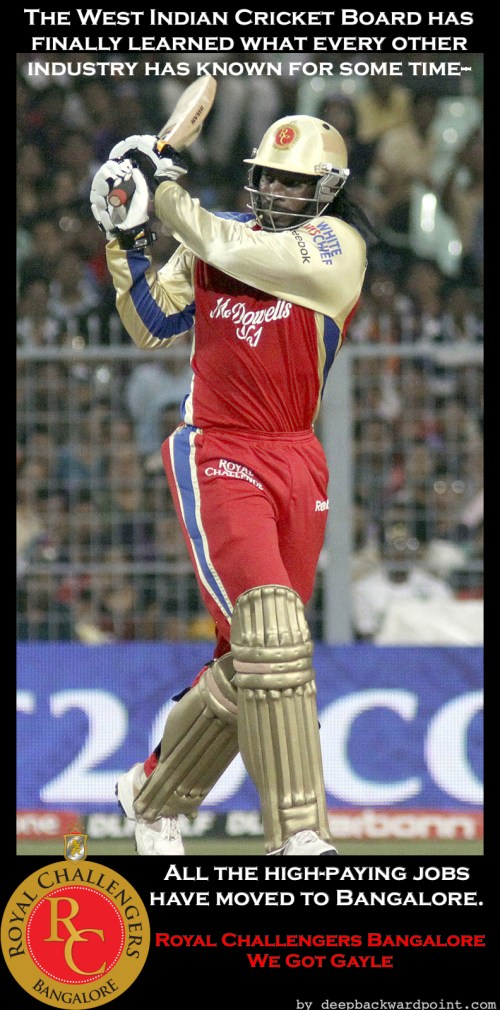
West Indies have learned what other industries have known for some time-- all the high-paying jobs have moved to Bangalore!
Ducking Beamers asks: what is the objective of a domestic player in the IPL?
But does it ever really translate into something more meaningful for these players? [..] Is it worth it for most of these players? Look at the top run getters and wicket-takers of 2009 — not many no-names there. A cursory look at the other seasons shows the same trends — a few low-fame players (Vinay Kumar, N. Ohja, A.T. Rayadu) — but not much else.
So, what is the objective?
Short answer: to increase your salary next year.
Long answer:
In fact, I would argue that in a tournament like the IPL where there is no real allegiance to the team, the goal of every single player is to be worth more next year.

Image by Dhammika Heenpella / Images of Sri Lanka via Flickr
Malinga on his return to the international game in 2009:
“Because of the IPL I got a chance to come back to the national team,” he said at a media conference in Colombo. “After the injury nobody looked after me and I was not offered a contract. But thanks to the IPL I didn’t lose anything but I improved my cricket a lot. I’m saddened the way I was treated but not disappointed.”
The IPL takes a lot of heat for ruining the international game. Malinga’s retirement has been held up as an example of everything that’s wrong with the IPL, but without the IPL he may not have had a career to retire from.
David Hopps on Yorkshire:
One of the oddities of English cricketing life is the underlying hostility felt towards the national team from a section of the Yorkshire cricket-loving public. The assumption is that supporting England is somehow not entirely wholesome, and is likely to be followed by other errors of life such as marrying someone from Kent and buying a four-bedroom detached in Tunbridge Wells.
∞
Any guesses why:
 Deep Backward Point