Deep Backward Point

Blog against the machine.

Tag: India

The Very Last Thing on Willow TV: a Boredwaani

I was invited to appear on a couple of episodes of the popular podcast Boredwaani on Bored Cricket Crazy Indians, the first of which is up on their site today.

In this episode, Samir Chopra, the Cricket Couch and I talk about our experiences with Willow TV both as past loyal customers as well as the more recent issues.

Thanks to Subash, Samir and Homer for making this happen.

India v. West Indies: Heads I Win, Tails You Lose

I know I’ve been harping on this all day, but I have one more thing to add. First, from Cricinfo:

In all, India are without Tendulkar, Dhoni, Sehwag, Yuvraj, Zaheer, Gambhir and Ashish Nehra for the ODIs. They will also have to do without Tendulkar, Sehwag, Gambhir and Pujara for the Tests.

Here’s what I have to say: if India lose to the West Indies, perhaps someone of some importance will start taking this issue seriously.

If India wins against the West Indies, god help us. If India wins, it means two things:

  1. An Indian B-team is good enough to beat the current top West Indies team at home.
  2. No one will take seriously the schedule and conflict of interest issues highlighted by the the top-half of the team sitting this one out.

Who Looks Out for Indian Cricket

Ultimately a lot of this boils down to conflict of interest, which is what Sharda Ugra was referring to in my last post. Who is looking out for the interest of “Indian cricket”?. Here’s Kartikeya at A Cricketing View:

If it is Leipus’s job to make sure that KKR players are able to play for KKR for the 6 or 7 weeks that the IPL is on, and forget about what happens during the other 45 weeks in the year, then he’s doing it well. KKR have insisted that Gambhir was “fit” to play their final game on May 25. But if his job is to be Gautam Gambhir’s doctor, then he’s done it poorly – Gambhir’s likely to miss a number of games because of an injury which worsened under Leipus’s care. These are two very different job descriptions, and it is up to you to decide which one you choose.

I’m not trying to fault the IPL or BCCI. Not entirely. But someone with authority has to look further than a couple of months, clear-headed, with only the good of Indian cricket at heart. There doesn’t seem to be anyone with the financial incentive and authority to do so. A player’s association would serve as counter-balance, but it may not be enough.

The Atul Bedade Syndrome

The year was 1993 and the manager of the Indian cricket team, Ajit Wadekar, had just had a heart attack. Skipper Mohd. Azharuddin was working hard to keep the news from his team. India was about to face the UAE in their international debut. India was returning to Sharjah after a more than two year hiatus, for the first time since Aaqib Javed‘s humiliating hat-trick of LBWs.

More importantly, for the purpose of our little tale, a young man from my childhood home of Baroda was about to make his debut. The word on the street was that the only way he scored runs was in sixes. Atul Bedade brought a fierce reputation from the domestic game. He promised to be Jayasuriya before Jayasuriya, Yusuf Pathan before Yusuf Pathan. He walked in at four down with a few overs to go and left with a whimper.

And so it went with the rest of his career. As he would walk in, the commentary team would inevitably say something like “the bowler should be worried, this man can hit everything out of the park.” Atul Bedade was expected to and tried to hit everything out of the park. In seven months and thirteen matches he hit 158 runs, thirty of which came in sixes. And then he receded in to obscurity.

There were quite a few reasons I started thinking about Bedade recently.

  1. Bedade may have thrived in the IPL. For a season or two, but maybe more.
  2. Afridi’s recent batting career is a classic Bedade. More appropriately, Bedade’s career was like recent Afridi. Not a real comparison, of course– Afridi the bowler, and Afridi the (former) explosive batsman have been terrifying limited over opponents. Alhamdulilah, indeed.
  3. I can only think of three batsmen who have lived up to the kind of hype I addressed above for long innings and a long career: Sehwag, Jayasuriya and Gilchrist. Not coincidentally, all of them have done well in Test cricket.

The B Team Goes to the West Indies

Kartikeya is disappointed in the Indian seniors for choosing not to play the ODI series in West Indies:

I hope the West Indies teach India a lesson in the upcoming ODI games. I understand the need for rest, but to choose the IPL over International Cricket is unconscionable, especially when playing for India is high paying employment.

I empathize. But I also find it interesting that while the rest of the world frets over the health of Test cricket, the top Indian players choose to ignore meaningless ODI series.

Strauss

England Move in to an Era of Better Hair

English Cricket Enters an Era of Better Hair

While the world worries about a three captain strategy, what worried me even more was the unceremonious limited overs retirement of Andrew Strauss.

As an India fan, this has been especially perplexing. A few weeks ago, Strauss played the 2nd-most devastating knock of the World Cup, after Taylor’s decimation of Pakistan. And now he retires.

While his 2011 hasn’t been great, 2010 was the best year of his career. In 14 innings, he scored at an average of almost 58, a strike rate near 100 with two 100s and eight 50s. In 2010, he had more 50s, more 100s, more 4s, more 6s, a higher average, a higher strike rate and more runs than any other year in his career.

It’s not as though England are having a terrific ODI run, where they can afford to lose their top performer.

Alastair Cook is a fine batsman, made the cover of Wisden, has great hair and went to the right schools but– it’s been said a billion times– but why would you name an ODI captain who couldn’t even make the 15 of your World Cup squad? Pietersen, Broad and Shahzad were sent back home injured from the World Cup, and even then, Cook was not invited, which means effectively he is not in the top 18 picks for the England ODI team.

At least he won’t replace someone who actually deserved to be in the squad on cricketing merit. He’ll replacing the retiring Strauss.

Related articles
IPL: 100% Recycled Material, Dispose Without Guilt

Tariq Engineer reports for Cricinfo:

[A] cumulative total of 146.4 million viewers have watched all the games so far, a number that exceeds the 143.7 million that saw the entire 2010 season (60 games). This suggests that while the IPL continues to attract new fans, they are watching each game for shorter periods.

Two reasons come to mind:

  1. If you train your audience to respond only to the thrills, and not the sport, then sooner or later they will only tune in for the thrills. The IPL becomes one of the many programs to channel-surf through, between musical reality show #31 and political shouting match #33.
  2. Even in this short, thrilling format, most games are one-sided and decided early.
Of course, there’s always the possibility that audiences are just suffering from cricket or IPL fatigue.

The Kirsten Era: In Numbers

The Duncan Fletcher era is upon us. The Gary Kirsten era in Indian cricket has been quite something to watch. Especially when coupled with Mahendra Singh Dhoni. Here are some highlights, as I’ve been combing through the statistics of the past few years:

Test record:

  • India played 33 tests under Kirsten, won 16, lost 6, drawn 11.
  • In the previous 3 years, India won 11, lost 6 drawn 13.
  • Basically, India learned how to convert potential draws to wins. What Australia learned under Steve Waugh.
  • At home: 10 wins, 2 losses, 7 draws. Away: 6 wins, 4 losses, 4 draws.
  • Sri Lanka and South Africa are the only test teams to have beaten India in the Kirsten era.
  • Only 1 out of 12 series was lost (Sri Lanka in ’08). No test series have been lost under Dhoni.
  • In the previous 3 years, 3 out of 11 series were lost.

One Day record:

  • India played 93 ODIs under Kirsten, won 59, lost 29 and tied 1.
  • In the previous 3 years, India won 48 and lost 42. The win percentage has gone up dramatically.
  • India won 14 out of 21 ODI series, including the World Cup.
  • Home: 24 wins, 7 losses, 1 tied. Away: 35 wins, 22 losses.
  • In the previous 3 years, India lost more away ODIs than they won. This is where their improvement has been most obvious.
In a way, this is merely a continuation of the 21st century revolution.

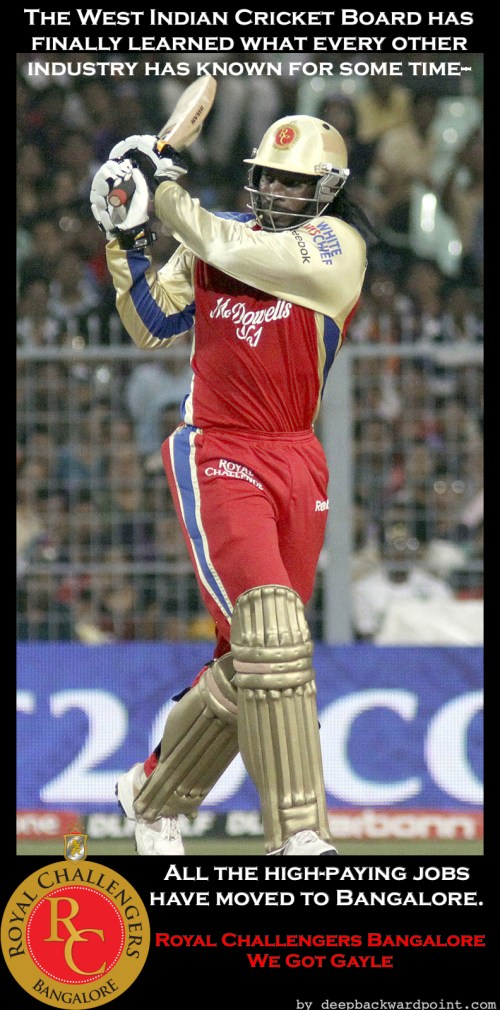
All the High-Paying Jobs Have Moved to Bangalore

Fake Royal Challengers Bangalore Advertisement

West Indies have learned what other industries have known for some time-- all the high-paying jobs have moved to Bangalore!

The Objective of Playing in the IPL

Ducking Beamers asks: what is the objective of a domestic player in the IPL?

But does it ever really translate into something more meaningful for these players? [..] Is it worth it for most of these players? Look at the top run getters and wicket-takers of 2009 — not many no-names there. A cursory look at the other seasons shows the same trends — a few low-fame players (Vinay Kumar, N. Ohja, A.T. Rayadu) — but not much else.

So, what is the objective?

Short answer: to increase your salary next year.

Long answer:

  • There’s an off chance they make it to the internationals.
  • They make a considerable amount of money.
  • It’s not like they don’t contribute to a win, just because they don’t figure in the top 10 wickets/runs. Just take a look at today’s RCB v. DD match: Ojha, Rao, Mithun, Mohammed all played significant roles. And that’s where it gets interesting– if they do well this year, even if they don’t get selected for India, their IPL salary next year will go up considerably.

In fact, I would argue that in a tournament like the IPL where there is no real allegiance to the team, the goal of every single player is to be worth more next year.