Deep Backward Point

Blog against the machine.

The Post-Tendulkar Era

UPDATE: As CricSis blogger Shridhar Jaju pointed out in the comments, Jaidev Unadkat beat Abhinav Mukund to this distinction.

A new era has begun. Abhinav Mukund will open the batting today against West Indies.

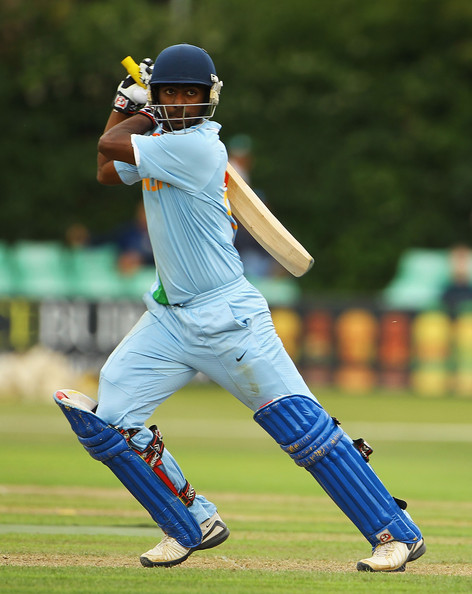
Why is Abhinav Mukund special? He is the first Indian Test player to have been born after Sachin Tendulkar made his debut. There will be many more, but he is the first.

Abhinav Mukund

Abhinav Mukund, born January 6, 1990. 52 days after Sachin Tendulkar's debut

Tape Delay Cricket

Samir Chopra elaborates on the story he told in the Boredwaani podcast a couple of weeks ago. Some times, even one day cricket demands patience from its viewers:

When the 1996 World Cup rolled around, I was living with my girlfriend in Manhattan, and working in the Bronx. The day-night games began early in the morning and ended in the afternoon. I would only be able to watch an over or two live before I had to leave for work to begin the long subway ride on the D train, uptown to the Bronx. The extended-play mode of the videocassette, and an extremely patient girlfriend came to the rescue. I would leave after having set up the VCR with a tape in EP mode; my girlfriend, who worked at Rockefeller Center, would walk back at lunchtime to our apartment, change the tape, and then return to work; the two tapes added up to more than eight hours, more than enough for a one-day international.

Though, someone should have taken mercy and warned him about the Calcutta semi-finals.

The (Lack of) Future Tours Programme

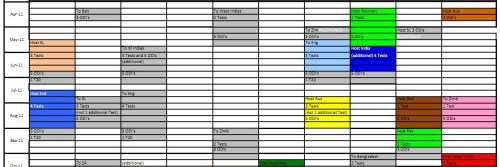
I was looking at the fabled ICC Future Tours Programme to see what’s going on in cricket over the next year:

Future Tours Programme Excerpt: 2011

Each column is the schedule for a single team between April 2011 and October 2011. Notice the two blank columns? Those are two teams who have no international cricket between the World Cup and October.

Those teams are New Zealand and South Africa.

Come October, South Africa still has an interesting few months. They host Australia for 2 Tests and a handful of ODIs, followed by Sri Lanka for another 2 Tests and another handful of ODIs.

New Zealand, on the other hand, has the most dull 2011 in the universe. They play Zimbabwe twice with a tour of Australia sandwiched between. Pathetic.

Dysfunction Junction: The Sri Lankan Edition

These days, it’s hard to figure out which cricket establishment is the most dysfunctional.

Behind door #1, we have Pakistan, stuck in a perpetual retire-ban-fix-rinse-repeat cycle. Behind door #2, we have West Indies, who keep their best batsman out of the team out of pure spite. Behind a newly emerging door #3, we have Cricket Australia, who were taken by surprise when a feisty Simon Katich pulled an Afridi by taking them on publicly.

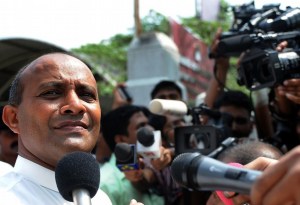
Hashan Tilakaratne

Hashan Tilakaratne of the United National Party, not to be confused with the United People's Free Alliance

But today, I want to talk about door #4: Sri Lanka. Let me connect the dots in this strange political brew.

  1. Hashan Tilakaratne has accused Sanath Jayasuriya and Aravinda de Silva of match-fixing.
  2. Sanath Jayasuriya has been recalled to the ODI squad at the age of 41.9, only to announce that he will retire after the first game.
  3. Upul Tharanga has been kept out of the team, after testing positive for banned substances.
  4. Arjuna Ranatunga claims that the doctor who prescribed the banned substance to Tharanga is also the Sri Lankan president’s personal physician, Eliyantha White.
  5. Eliyantha White’s medical credentials are “not known“.
  6. Sri Lankan president, Mahinda Rajapaksa, belongs to the United People’s Freedom Alliance.
  7. Sanath Jayasuriya is a Member of Parliament from the same party.
  8. Arjuna Ranatunga is a Member of Parliament from Democratic National Alliance.
  9. Hashan Tilakaratne is a Member of Parliament from United National Party.
  10. All three of them are in separate parliamentary alliances, as far as I can tell.
It’s all very Monty Python.

Poor and Lonely: Cricket in the USA

Raza Naqvi, on watching cricket in the USA:

And so cricket, here in America, is not only watched in poor quality, it is watched alone.

Crickets Advertising Cricket

ECB has taken to painting crickets (the insect) to promote T20 cricket (the game). Liam Brickhill reports:

Following their photoshoot, the logoed crickets were re-released back into the wild outside the stadium of their representative team. The organisers of the stunt hope children and adults will find the brightly-coloured insects – presumably before any birds or insectivorous mammals spot them – and ultimately get behind their county.

Good luck, crickets. I’m sure being brightly-colored makes it easier to avoid cricket-eating creatures.

The Pattern of Indian ODI Chases in 2011

As I watched India (barely) successfully chase 225 with 3 wickets to spare against West Indies on Saturday, it seemed that a pattern had emerged. This match resembled many Indian chases in recent times, where it would appear the batting line-up failed, but it would still be a successful chase because they bat so deep.

So I went over their recent record in seven consecutive successful chases since the World Cup began:

  1. India v. Ireland (World Cup): Ireland scored 207 batting first. India’s chase seemed to falter, wickets fell regularly (100 for 4), but runs kept coming as India won with 4 overs and 5 wickets to spare. (scoreboard)
  2. India v. the Netherlands (World Cup): The Netherlands scored 189 batting first. India’s chase again seemed to falter, wickets fell regularly (139 for 5), but they won by 5 wickets with 13.3. overs to spare. (scoreboard)
  3. India v. Australia (World Cup): In the quarter-finals, Australia scored 260 batting first. India’s lost wickets regularly (167 for 5), but kept the scoring rate up and ultimately chased it down with 5 wickets and 3 overs to spare. (scoreboard)
  4. India v. Sri Lanka (World Cup): In the finals, Sri Lanka scored 274 batting first. India lost their openers cheaply, but kept the scoring rate up to win by 6 wickets with 10 balls to spare. (scoreboard)
  5. India v. West Indies, 1st ODI: West Indies score 214 batting first. India lose wickets regularly, but bat deep to chase it down with 4 wickets and 3 overs to spare. (scoreboard)
  6. India v. West Indies, 2nd ODI: This one doesn’t fit the mold. West Indies score 240, and in a rain-shortened match, Virat Kohli and Parthiv Patel make it look easy, winning with 7 wickets to spare. (scoreboard)
  7. India v. West Indies, 3rd ODI: Chasing 225, India lose wickets in a heap (92 for 6), but Rohit Sharma, Harbhajan Singh and some late hitting by Praveen Kumar rescue them. India wins by 3 wickets with 3.4 overs to spare. (scoreboard)
A few obvious notes to make:
  • None of these chases would have been possible without great bowling upfront to restrict the opposition.
  • India bats very, very deep.
  • The key seems to be that even as wickets fell, the scoring rate didn’t drop in these games. The asking rate was never too imposing for the new batsmen.
  • This style of chasing seems inspired by T20. Many short quick innings, instead of a couple of long, deliberate ones.
  • I started the list after the South Africa series. India chased poorly against South Africa.

Do as I Say, Not as I Do

Salman Butt watches the money roll in

Salman Butt:

“Kids watch you and want to become you (Afridi) or Imran or Wasim, so don’t leave them with examples that are not there to follow.”

Jackass.

(via Sana Kazmi, who sat through an excruciating series of Salman Butt interviews to pull out the gems. She did it so you don’t have to. Be grateful.)

The Sports Illustrated Fizzle

On 6th May, 2011, the story broke: Sports Illustrated India had a big match-fixing cover story. More than a month later, turns out what they had was either circumstantial, hearsay or just plain bunk.

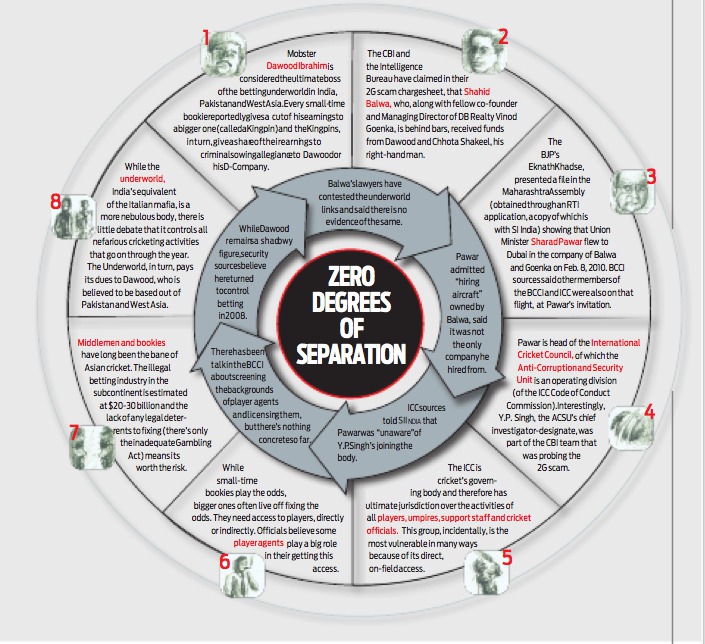
Here’s their silly central conceit, in awesome pictorial form:

Sports Illustrated Plays Six Degrees of Kevin Bacon, Loses

Go on, and read the rest of the article. Actually, don’t. It is a terrible piece of journalism, as evidenced by the picture above. They either had no story, or had no one to back up the story they had. Either way, the story they ran with was this.

Bad people have been seen with other people who have been heard talking to these other people who may represent cricket players. Or not.

Also, what kind of magazine has no web site? For a brand like Sports Illustrated, with a story as “big” as the one they broke last month, to not have a web site is criminal. I could go on a rant like my epic Willow TV one, but I just don’t care about SI the way I care about Willow. So someone else will have to fight that battle.

I’ll just say that they need to hire a web developer. And real journalists.
Miandad as a Microcosm of Pakistan

Javed Miandad encompasses almost everything that makes Pakistan the most entertaining team of them all. Rob Bagchi and Rob Smyth recall one of the great innings of all time, where Miandad scored 200 not out of a total of 311:

Wickets continued to fall at the other end: 155 for five, 224 for six, 227 for seven. Then Javed added 43 for the eighth wicket with Robin Hobbs – who was out first ball. It was an astonishing partnership, with Javed facing every delivery for eight consecutive overs. His plan was simple: wait for the field to come up for the fifth delivery, hit over the top for a boundary, and then gleefully steal a single from the last ball. It was a delicious game of cat and mouse, except the mouse was terrorising the cat.

This innings on its own is a microcosm for Pakistani cricket. Including how the innings ended.