Deep Backward Point

Blog against the machine.

That’s Nice Dear

Andy Zaltzman, on the greatest discovery of his life:

I opened the front cover. Inside was a small piece of white card, stuck down by the previous owner with some blu-tac. On it was an autograph. Clearly written, and unmistakeable. Don Bradman. I exploded with excitement. “That’s nice, dear,” said my mother, trying half-heartedly to look like she knew or cared who Don Bradman was, and wondering what she had done wrong in my formative early years.

The Case Against (and For) Ahmedabad

Jayaditya Gupta recounts the case against Ahmedabad as an international cricket destination:

Scyld Berry unequivocally called it “without doubt the most unpopular venue on the whole international cricket circuit”. Michael Henderson, writing after England’s engagement here on their 2001-02 tour: “Rarely can a group of sportsmen have been so relieved to put a place behind them, a place of dirt, unrelieved boredom, inadequate facilities, no booze, and, in England’s case, illness.” More recently Paul Winslow of the Barmy Army said Ahmedabad had “little else to offer” other than cricket.

Jayaditya Gupta’s adopted home is Ahmedabad. It’s mine as well– I’ve spent every summer and many weekends of my childhood there, playing lonely cricket against a wall, playing cricket with family, playing book cricket, playing the table-top cricket game Gold Cup, watching cricket, and so forth.

Ahmedabad Panorama by Hardik Jadeja

Some day, I’ll write an ode to Gold Cup. And to book cricket. And to lonely cricket against a wall.

Gupta tries to lay down the case for the city:

Yet slowly I saw the similarity with, first, my native east – in the sweetness, metaphorically, of the language, and in the sweetness, literally, of the food – and with the West, in the professionalism of my colleagues, in their time-management (time is money: in the six years I spent in Gujarat, not one day’s work was missed on account of a general strike or political agitation, unlike the countless man-days lost in union-run Bengal). I saw a society that was inherently democratic, reflected in the universal suffix “bhai” or “ben” appended to all names, regardless of age, caste, creed.

The Sachin Tendulkar Era: Part I

One Hundred and Thirty Nine cricketers have represented India in One Day Internationals since Sachin Tendulkar made his debut against Pakistan in November 1989.

This is their story.

The Sachin Era- Part I

The Sachin Era- Part I

[Click for larger version] [Click for PDF with ability to zoom all the way in on every name]

Acknowledgements: Created with the help of Cricinfo Statsguru, Wordle, MS Excel, custom Python scripts and Acorn.

The ‘Ridiculous’ World Cup Schedule

Kevin Pietersen questions the World Cup schedule:

Pietersen also criticised the format of the six-week long tournament, saying the gaps between matches were too long. “How can the England team play once and then in six days’ time play again, and then in six days’ time play again,” he asked.

That’s what I’ve been wondering. TV revenue for the win!  Read the rest of this entry »

A Mars Bar at Good Length

Steven Lynch makes a list of the beefiest cricketers in history.

On Ranatunga:

Shane Warne was once despairing of luring Ranatunga out of his crease to maximise the possibility of a stumping: wicketkeeper Ian Healy helpfully advised: “Put a Mars bar on a good length, that should do it.” Ranatunga, whose bat once sported an advert for “Sam’s Chicken and Ribs”, shot back “if you do, I bet David Boon will get there first”.

And some epic bit of sledging from the portly Jimmy Ormond:

[Ormond was] berated by Mark Waugh as not good enough for Test cricket, he replied: “At least I’m the best cricketer in my family.”

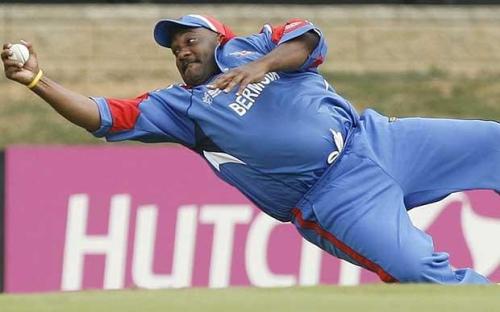
Also, anyone remember Dwayne Leverock’s moment of glory?

Dwayne Leverock of Bermuda

Dwayne Leverock of Bermuda takes Robin Uthappa's catch at the 2007 World Cup

Who is this Aaron Finch character?

Dirk Nannes on the IPL’s $300k surprise:

Yes, he drinks. Yes, he smokes. Yes, he blows bubbles with his gum when a bowler is running in to bowl. Yes he picks a fight with his quick mouth on the field. But he’s a damn fine cricketer and will always be one of the first picked in my team.

via Who is this Aaron Finch character? | Dirk Nannes.

India’s Path to the World Cup Finals

Never Again

Never Again.

The Cricket World Cup is still three weeks away, but it’s never too early to lay out a hypothetical situation.

The Group of Death
The fourteen teams competing in the World Cup are divided into two groups. The top four in each will make it to the quarter-finals.

First, take a look at the two groups:

Group B Group A
  • Bangladesh
  • England
  • India
  • Ireland
  • Netherlands
  • South Africa
  • West Indies
  • Australia
  • Canada
  • Kenya
  • New Zealand
  • Pakistan
  • Sri Lanka
  • Zimbabwe

One of these things is not like the other. Clearly, based on recent form, Group B is the group of death.

100 Hundred Overs = 98 Ad Breaks
Thankfully for the members of Group B, cricket is ruled by a powerful few, and their television revenues. The ICC cannot afford (another) World Cup where the most popular teams fail to make it to the later rounds. For this reason, four teams from each group will qualify for the next round– which should make sure most, if not all, of the high advertising-revenue countries will play the quarter-finals.

Note: Of course, major upsets are always possible, as we saw in 2003. And 2007. Just ask Bob Woolmer. In all seriousness, statistically, a single upset among eight teams is likely. If I had to guess, Bangladesh could beat West Indies to a quarter-final slot. Pakistan, New Zealand and India also have the tendency to vastly under or over-perform, but never meet expectations.

So, in all likelihood, the usual suspects will make it to the quarter-finals. For sake of argument, my nominal prediction:

  • A1: Australia
  • A2: Sri Lanka
  • A3: New Zealand
  • A4: Pakistan
  • B1: South Africa
  • B2: India
  • B3: England
  • B4: West Indies

For the most part, the ranking within the group does not matter. You could come fourth in your group, and still make the quarter-finals. Except, if you’re in Group B, this will likely mean you have an early date with Australia.

[Note: And no one wants an early date with Australia. Not even New Zealand. They live next door, they would know.]

On the other hand, a top-three place within Group B would (likely) ensure avoiding Australia until at least the semi-final. The other three potential opponents are deadly on their day– and Sri Lanka in the sub-continent can be lethal– but if I had to choose when to meet Australia, I would choose the finals.

[Note: In reality, I would choose never, or when the moon turned blue, or when Ponting returns to form.]

[Note: Note to self: never bet against Ponting.]

Location, Location, Location
There is another wrinkle in the story.

If India finish second or fourth in their group, they play their quarter-finals in Dhaka, Bangladesh.

If India finish third in their group, they play in Colombo, Sri Lanka. If, simultaneously, Sri Lanka finish second in their group India play Sri Lanka in Colombo. Short of playing Australia, this is probably the second worst-case quarter-final scenario.

Here’s the best case: If India finish at the top of their group, they play at Sardar Patel Stadium in Ahmedabad, India. India does not have a terrific One Day record in Ahmedabad (winning only five of twelve), but they would prefer a home ground to Dhaka or Colombo any day.

[Note: India has a better record at Dhaka, but that’s only because they played Bangladesh. The three times they have lost were to Sri Lanka and Pakistan. India’s recent record at the Premadasa in Colombo, isn’t too bad either. They have defeated Sri Lanka five of the last seven times in the past two years.]

As an added benefit, the winner here would play their semi-final in Mohali instead of Colombo. And everybody loves Mohali, right? Right?

[Note: India have lost their last three ODIs in Mohali.]

#1, #1. #1
In short, while the early stages of the World Cup are largely meaningless (as they have been for some time), there are a few minor goals to shoot for.

If they finish in the top three in their group, India may be able to avoid Australia. For now.

If the they finish on top, they have the home advantage and most likely avoid Australia until the finals. And avoid a repeat of 2003. And hope someone else beats Australia before them.

A Royal Pair at Moti Baug in Baroda

This is where I watched my first cricket match ever– Australia Vs. Rest of India in ’86– and my first international– India Vs. Sri Lanka in ’87. Writes Bharat Sundaresan for Indian Express:

The Prince of Udaipur leaps in joy as his team vanquishes yet another opponent with consummate ease while not far away, the Yuvraj of Baroda sits morosely, wondering about what could have been. [..]

[P]icturesque Moti Baug ground in Baroda offers a regal blast-from-the-past, a ‘royal tent’. It’s from here that the Gaekwads have lent their gracious presence for cricket matches during the last century.

“The tent used to be much bigger, but unfortunately it got eaten up by termites. I have grown up watching cricket from here,” says Samarjitsingh, presently a member of the Baroda Cricket Association.

Later, the prince of Rajasthan says:

“I am sure the souls of the past greats from my state, including my grandfather, will be popping champagne bottles as we speak”

Not in this dry state they won’t. Even souls can’t drink in Gujarat. Unless they’re considered other-worldly foreigners, in which case they can show their passport and get a permit.

The Next Ashes: Ten Consecutive Test Matches

This will either be an epic battle or an epic bore. Andre Wu for the Sydney Morning Herald:

In what is shaping as a bumper few years for Australian cricket fans and Cricket Australia’s bean-counters, the fierce rivals will play 10 consecutive Tests in two separate series in the second half of 2013 and early 2014..

Let’s hope England remains a top-notch team, and Australia continues to play every test match to win.

One-day cricket’s acid test

Bhogle waxes poetic about the potential for another insipid world cup, but manages to avoid mentioning the elephant in the room– Twenty20.

If indeed the viewership and attendance tend to be too strongly skewed, if games not involving the top four or five leave people disenchanted, it would mean that the ICC’s decision to have no more than 10 teams for the 2015 World Cup is right.

It’s a tournament planned to maximize television revenue. It’s a form of the game that’s simultaneously too long and too short. A leaner, meaner version in 2015 may be fine, but euthanasia is even better.