Deep Backward Point

Blog against the machine.

Tag: England

The History of One Day Cricket: Part I

The One Day International has changed dramatically in its 40 years of existence. Here is part one of my analysis of the game:

Highest Score per team, per year

We’ve come a long way since the ’70s. It used to be a 60-over innings and teams barely got a couple of hundred runs. In 1977, no team made more than 250 in their allotted 60 overs. Every year since 2004, the top eight teams have had a 300+ score every year. We’ve come a long way, baby.

Take a look at how Jayasuriya and company changed the game in 1996. It’s an outlier, so different from the years around it and wouldn’t be surpassed until the batting powerplay was instituted in 2006.

Highest Score of World Cup 2011: 375 by India against Bangladesh

High Scores in One Day History

High Scores in One Day History (click for larger version)

Runs per over per team, per year

We’ve gone from a par average of 4 to a par average of 5.5. In 1994, every team had a yearly run rate of 5 and under. By 2010, every team was over 5. In fact, South Africa finished 2010 at 6 runs per over for the year.

Top 8 Teams Run Rate at World Cup 2011: 5.38
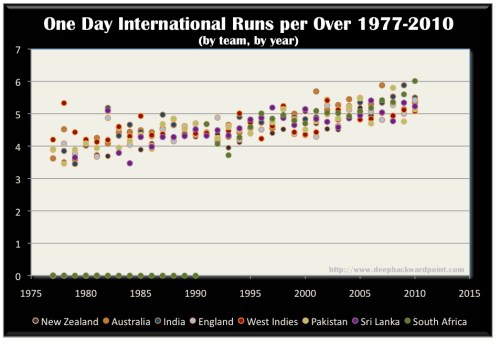
Run Rate by Year in One Day History

Run Rate by Year in One Day History (click for larger version)

Runs per wicket per team, per year

Now here’s something that hasn’t changed much as the game has changed. Even though teams are scoring at a (much) faster pace, the runs per wicket has been largely steady. Barring some outliers (West Indies in the early days, Australia in the last 10 years), the average has barely increased from the upper 20’s to the low 30’s.

In both this chart and the runs per over, Sri Lanka’s progress between say 1983 and 1996 has been the most dramatic. On this chart, Sri Lanka goes from about 18 in 1984 to 38 in 1997. Of note: Australia crossed 50 runs per wicket in 2001.

Also, look how the mighty have fallen. West Indies dominates every chart here for the first decade and then drops off the map. Finally, the era of Aussie dominance ended in 2008- the orange dot on all three charts falls from the top that year.

World Cup 2011: Matches Among Top 8 Teams:
Side Batting First: 29.58 Runs per Wicket
Side Batting Second: 31.61 Runs per Wicket
Overall: 30.49
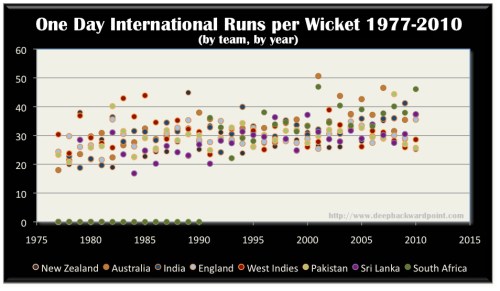
Average per wicket per year in One Day History

Average per wicket per year in One Day History (click for larger version)

In the next installment, I will present three charts on how the balance of power in one day internationals has changed over 40 years.

Notes:

  • Only the top eight teams (no Zimbabwe, no Bangladesh) have been considered.
  • The runs per over are for the entire year, with each dot representing a different team.
  • The runs per wicket are for the entire year, with each dot representing a different team.
  • The highest score is the highest score for a particular team in that year.
  • The color code for each country is consistent across all charts.
  • Statistics until the end of 2010 are reflected in the charts.

Look How Far We’ve Come

The 5th Test: South Africa v England at Durban, Mar 3-14, 1939:

The “Timeless Test” [was] 10 days long and finally called off because the Englishmen had to catch the boat home. At a rate of 2 runs every 6 balls, they scored over 1800 runs in 10 days.

Sounds like the current World Cup. Except no one has a boat to catch, so it just keeps going…

England: Producing Excitement Through Mediocrity

There have been two good and two great cricket matches in the World Cup so far:

  1. England v. Netherlands: Netherlands bats first, scores 292 on the back of a ten Doeschate blinder and England falter a bit before winning.
  2. Sri Lanka v Pakistan: Sri Lanka fail to chase a total within their reach against a never-say-die Pakistan bowling attack.
  3. England v. India: India bat England out of the game. Then England almost walk away with it. Zaheer brings India right back. And it’s a tie.
  4. England v. Ireland: England bat Ireland out of the game. Ireland collapses, before Kevin O’Brien walks away with it.

Do you sense a pattern? England was involved in three of the four games. They’ve produced exciting matches by vastly under-performing.

On the other hand, two teams produced excitement by over-performing: Ireland and Pakistan.

In fact, Pakistan and England have had diametrically opposite performances in the World Cup so far.

England: Top order fires, middle-order misfires and bowlers don’t show up to work.

Pakistan: Top order fails, middle-order rescues and bowlers save the day.

The Birth of One Day Cricket

Photo of Don Bradman taken the MCG, Melbourne ...

Image via Wikipedia

Andy Bull remembers the day One Day cricket was born:

When the match was called off on the third day, Bradman himself climbed up the steps to the press box and announced that a seventh Test had been bolted on to the back-end of the England tour. And, as a short-term sop to the sports-starved Melbourne public, a Gillette Cup style ‘limited-overs Test’ would be played between the two teams at the MCG on what would have been the fifth day.

The ‘Ridiculous’ World Cup Schedule

Kevin Pietersen questions the World Cup schedule:

Pietersen also criticised the format of the six-week long tournament, saying the gaps between matches were too long. “How can the England team play once and then in six days’ time play again, and then in six days’ time play again,” he asked.

That’s what I’ve been wondering. TV revenue for the win!  Read the rest of this entry »

The Next Ashes: Ten Consecutive Test Matches

This will either be an epic battle or an epic bore. Andre Wu for the Sydney Morning Herald:

In what is shaping as a bumper few years for Australian cricket fans and Cricket Australia’s bean-counters, the fierce rivals will play 10 consecutive Tests in two separate series in the second half of 2013 and early 2014..

Let’s hope England remains a top-notch team, and Australia continues to play every test match to win.