Deep Backward Point

Blog against the machine.

Tag: India

How the Girls Got to Mohali

At the end of the guard changing ceremony at t...

(via Wikipedia)

I’m a little late to link to this, but here’s the remarkable story of how three girls from Pakistan got to the semi-finals in  Mohali. I was following this on Twitter as it unfolded, and then suddenly the twitter account (@sanakazmi) went silent. The day after the game, she reported that they had made it to the game:

[W]e started a #getthegirlstomohali hashtag on twitter asking for ticket/visa information, and secretly hoping for ridiculous favours. We had 5 days to get visas, find match tickets and get on a plane or a train or a taxi to Mohali. How hard could it be?

Pretty much all the information I got on how to make this cricket pilgrimage happen – from the link to the right visa form to where in Islamabad I could find a printer at 5AM – came from twitter.

Heartwarming.

The Day I Was Dhoni

The year was 1996. Sachin Tendulkar was already a legend. Mahendra Singh Dhoni was not even a ticket collector. The school Sports Day was approaching. There was only one question on everyone’s mind:

Would Vinay House remain the laughing stock of the school?

Let’s back up for a second.

Now that Harry Potter has taken over the world, even the gringos are probably familiar with the “house” system that divides schools across the commonwealth into groups that compete in everything from football to quiz competitions.

I wish I could tell you that my house– the mauve hued Vinay House– was the Gryffindor of our school. Frankly, I would have settled for Ravenclaw.

No, sadly, we were the Hufflepuff of our school. We were the nice guys who finished last. You know all the kids Grace said adored Ferris Bueller? Yeah, they were in Vinay House.

Enough with the pop culture analogies. For now.

Sports Day began with each house marching past the flag, the audience and the chief guest. The chief guest would be some local politician, or local sports star (Kiran More!), or, one time, when the real celeb canceled, it was my father. No, my father is not famous, unless you are a cancer cell. In which case, you’d know him like assassination-victims knew Jason Bourne.

Vinay House would march past doing a Three Stooges routine, followed by the rest of the houses in perfect rhythm to the drum beat. This would be followed by a few track and field events, the final tally of the points and the chief guest would hand out the trophies.

Yes, my father once handed me a trophy in front of the entire school. It was awkward.

Before we got to this day, every sporting event had to be complete, the scores tallied, the points allotted. Which brings us to the fateful cricket match.

Vinay House had already lost their first game, and were now in a battle for 3rd place. I was in the team. I was neither a bowler, nor a batsman, a sort of Darren Sammy without the captaincy. I came in at #10, with eight wickets down and some 12 runs yet to be chased.

And then we lost the 9th wicket. At #11, in walked a friend I had known for ten years, and neither of us were what you could call a Kevin O’Brien with the bat. Or even a Rizwan Cheema. Or even a Venkatpathy Raju.

It came down to the last few balls. I was on strike. 4-ish runs remained. One wicket in hand. One of my closest friends was bowling.

The ball was straight, and a little short, and I swung my Slazenger.

Let’s back up for a second.

Ok, sorry, let’s not.

Me "playing" cricket

Me "playing" cricket

I swung my Slazenger and the ball flew over Long On as the crowd rushed in. Six runs. Vinay House was not #4. On that day, at least.

Very quickly I was surrounded by my closest friends.

I did it for Sachin.

No, not really. Though I would have if he’d asked.

Notes:

  • The bowler and I are still close friends. Not sure if you could say the same about Dhoni and Nuwan Kulasekara.
  • One of the people who surrounded me after I hit that six is now my wife.
  • After that day, I announced my retirement from cricket. It was time to let in a new generation.
  • Also, they didn’t select me for the team the next year. So in a sense, you could say I also pulled a Ponting. “You can’t fire me, I quit!”

The History of One Day Cricket: Part I

The One Day International has changed dramatically in its 40 years of existence. Here is part one of my analysis of the game:

Highest Score per team, per year

We’ve come a long way since the ’70s. It used to be a 60-over innings and teams barely got a couple of hundred runs. In 1977, no team made more than 250 in their allotted 60 overs. Every year since 2004, the top eight teams have had a 300+ score every year. We’ve come a long way, baby.

Take a look at how Jayasuriya and company changed the game in 1996. It’s an outlier, so different from the years around it and wouldn’t be surpassed until the batting powerplay was instituted in 2006.

Highest Score of World Cup 2011: 375 by India against Bangladesh

High Scores in One Day History

High Scores in One Day History (click for larger version)

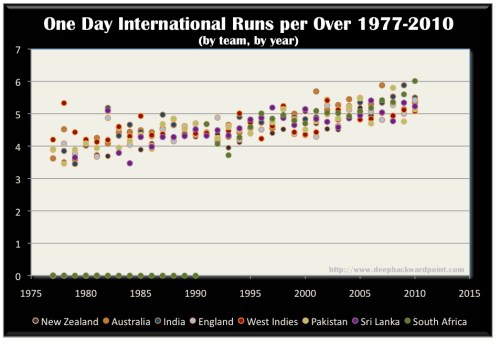
Runs per over per team, per year

We’ve gone from a par average of 4 to a par average of 5.5. In 1994, every team had a yearly run rate of 5 and under. By 2010, every team was over 5. In fact, South Africa finished 2010 at 6 runs per over for the year.

Top 8 Teams Run Rate at World Cup 2011: 5.38

Run Rate by Year in One Day History

Run Rate by Year in One Day History (click for larger version)

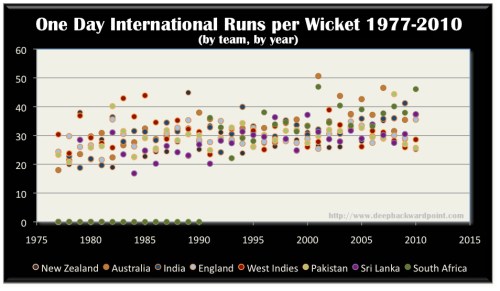
Runs per wicket per team, per year

Now here’s something that hasn’t changed much as the game has changed. Even though teams are scoring at a (much) faster pace, the runs per wicket has been largely steady. Barring some outliers (West Indies in the early days, Australia in the last 10 years), the average has barely increased from the upper 20’s to the low 30’s.

In both this chart and the runs per over, Sri Lanka’s progress between say 1983 and 1996 has been the most dramatic. On this chart, Sri Lanka goes from about 18 in 1984 to 38 in 1997. Of note: Australia crossed 50 runs per wicket in 2001.

Also, look how the mighty have fallen. West Indies dominates every chart here for the first decade and then drops off the map. Finally, the era of Aussie dominance ended in 2008- the orange dot on all three charts falls from the top that year.

World Cup 2011: Matches Among Top 8 Teams:
Side Batting First: 29.58 Runs per Wicket
Side Batting Second: 31.61 Runs per Wicket
Overall: 30.49

Average per wicket per year in One Day History

Average per wicket per year in One Day History (click for larger version)

In the next installment, I will present three charts on how the balance of power in one day internationals has changed over 40 years.

Notes:

  • Only the top eight teams (no Zimbabwe, no Bangladesh) have been considered.
  • The runs per over are for the entire year, with each dot representing a different team.
  • The runs per wicket are for the entire year, with each dot representing a different team.
  • The highest score is the highest score for a particular team in that year.
  • The color code for each country is consistent across all charts.
  • Statistics until the end of 2010 are reflected in the charts.

Why is This So Hard To Understand?

Shanaka Amarasinghe, on why Sri Lanka lost:

If there is one word that can sum up the difference between the two finalists of 2011, it would have to be “belief”.

No. If there was one word that could sum up the difference between the two finalists of 2011, it would have to be “skill”.

India Wins

India wins

The old warhorse

Two questions:

  1. When was the last time India went 37 overs without giving away a single extra?
  2. When was the last time India played only 5 bowlers in an innings?

Also, what a symmetrical bowling card:


India v. Pakistan Bowling Card

India v. Pakistan Bowling Card


Why I Love/Hate India v. Pakistan

Hate.
  1. Jingoism masked as patriotism.
  2. Religious hatred masked as sporting rivalry.
  3. Patriotism masked as a love of sport.
  4. The poisonous “Zaheer Khan miyo chhe etle full toss naakhyo” (translated: “Zaheer Khan is Muslim, that’s why he bowled a full toss.”) I wonder if they say the same about Kaneria on the other side.
  5. If they win, Kashmir.
  6. If they lose, allege match-fixing, commence stone-throwing, effigy-burning.

In short, it’s just not cricket.

At the end of the guard changing ceremony at t...

Image via Wikipedia

Love.

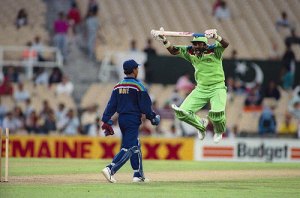
  1. Javed Miandad’s last ball six off Chetan Sharma.
  2. Anil Kumble’s 10 wickets in an innings.
  3. Aamer Sohail bowled Venkatesh Prasad.
  4. Ajay Jadeja’s quick-fire 45.
  5. A 19 year-old Tendulkar and 33 year-old Kapil Dev on fire in Sydney.
  6. Aaqib Javed’s hat-trick of LBWs.

Ok, strike that last one. I hate that.

The First Among Equals

On paper, India is the best of the remaining teams in the World Cup. But on paper strength has never meant much. On paper, India should score 350+ every match. On paper, South Africa should have made the finals of every World Cup since ’92.

Not much separates the top eight teams in the world, mainly because the good teams are inconsistent and the average teams are tenacious. It’s a time of great turmoil, as many teams rush to replace Australia at the top of the world.

In such a tournament, there is no favorite. As the semi-finals are about to begin, there is no obvious choice. This is new territory– Australia have been favorites to win for over a decade now.

In such a tournament, the winner deserves to be the winner by virtue of having won. That is to say, if a team manages to win three knockout games in a row against top-8 opposition, they deserve to be crowned world champions.
20110328-102230.jpg
The act of winning the World Cup will be the only thing that differentiates one of the remaining teams. And that is the characteristic of a great tournament.

India v Pakistan

Miandad and More

Miandad and More

King Cricket sums it up:

It’s India’s two-and-a-half frontline bowlers against Pakistan’s two-and-a-half competent batsmen.

Only partly tongue-in-cheek.

Breaking News: India’s Secret Weapon to Beat Australia

Three words: play excellent cricket.

There– now you don’t have to read or listen to all the experts.

Three Sentences That Capture the Debate Over Walking

Tendulkar Walks

Tendulkar Walks

Last week, Tendulkar walked after edging the ball to the ‘keeper, but Ponting didn’t. Andy Bull sums it up:

By walking [Tendulkar] gave a wonderful example to hundreds of millions of fans and spectators, which is more than you can say of what Ponting did. At the same time, what would those same fans think if he did it in the first over of the World Cup final? Ponder that, and you get close to understanding the merits of both sides of the argument.