Deep Backward Point

Blog against the machine.

Category: Link List

Do as I Say, Not as I Do

Salman Butt watches the money roll in

Salman Butt:

“Kids watch you and want to become you (Afridi) or Imran or Wasim, so don’t leave them with examples that are not there to follow.”

Jackass.

(via Sana Kazmi, who sat through an excruciating series of Salman Butt interviews to pull out the gems. She did it so you don’t have to. Be grateful.)

Miandad as a Microcosm of Pakistan

Javed Miandad encompasses almost everything that makes Pakistan the most entertaining team of them all. Rob Bagchi and Rob Smyth recall one of the great innings of all time, where Miandad scored 200 not out of a total of 311:

Wickets continued to fall at the other end: 155 for five, 224 for six, 227 for seven. Then Javed added 43 for the eighth wicket with Robin Hobbs – who was out first ball. It was an astonishing partnership, with Javed facing every delivery for eight consecutive overs. His plan was simple: wait for the field to come up for the fifth delivery, hit over the top for a boundary, and then gleefully steal a single from the last ball. It was a delicious game of cat and mouse, except the mouse was terrorising the cat.

This innings on its own is a microcosm for Pakistani cricket. Including how the innings ended.

The Violent 400-year History of Hitting the Ball Twice

Facing the first ball after tea, Tilakaratne Dilshan almost played the ball on to his stumps, but avoided getting out by hitting the ball a second time, away from the stumps. Law #34 of the laws of cricket states that you can only hit the ball twice if you intend to protect your wicket. If you intend to score runs from the second hit, you’re out. Which sounds kind of counter-intuitive, but there’s a reason.

Turns out that cricket has a violent 400-year history that involves people getting killed because some idiot took the opportunity to hit the ball once to set up a second monster hit for six. From Wikipedia:

In 1622, several parishioners of Boxgrove, near Chichester in West Sussex, were prosecuted for playing cricket in a churchyard on Sunday 5 May. There were three reasons for the prosecution: one was that it contravened a local bye-law; another reflected concern about church windows which may or may not have been broken; the third was that “a little childe had like to have her braines beaten out with a cricket batt”! The latter situation was because the rules at the time allowed the batsman to hit the ball more than once and so fielding near the batsman was very hazardous[.]

Also:

In 1624, a fatality occurred at Horsted Keynes in East Sussex when a fielder called Jasper Vinall was struck on the head by the batsman, Edward Tye, who was trying to hit the ball a second time to avoid being caught. Mr Vinall is thus the earliest known cricketing fatality. The matter was recorded in a coroner’s court, which returned a verdict of misadventure.

In 1647, another fatality was recorded at Selsey, West Sussex, when a fielder called Henry Brand was hit on the head by a batsman trying to hit the ball a second time.

Jasper Vinall is officially known as the first man to be killed by cricket. To be a close in fielder in 17th century (East or West) Sussex was as good as a death warrant, it turns out.

In the case of Dilshan, there was an added twist to the tale. He was caught off his second hit and the fielder appealed. Of course, you can’t be caught out off the second hit. This is the kind of detail about cricket that makes me smile.

Think about it:

  • When Dilshan hit the ball the first time, he was almost out bowled.
  • He hit the ball a second time, and was not out.
  • But if he then set off for a run, showing intent to score off the second hit, he would be ruled out.
  • He was caught, but since it was off the second hit, he was not out.
And people wonder why I love cricket.

Classic Cricket: Boris Karloff Arguing with C. Aubrey Smith at a Cricket Game

I’m going to try to dig up classic cricket photographs, but here’s the first. I’m sure there’s a fantastic story behind this one– it’s Frankenstein aka Boris Karloff, arguing with C. Aubrey Smith at a cricket game. C. Aubrey Smith captained England for one Test match, before making his way to Hollywood, where he founded the Hollywood Cricket Club. They created a pitch with imported English grass and attracted fellow expats such as David Niven, Laurence Olivier, and Boris Karloff to the club as well as local American players. Which is where this argument likely occurred.

Life.com won’t let me embed the picture here, so click to see it.
(via Life.com)

Obama, Married to Cricket

Classic Zaltzman:

(If anyone remains in any doubt about Obama’s obsession with English Test cricket, he married a woman whose forenames are Michelle LaVaughn. Case closed.) (Admittedly, they were married in 1992, before the English, male Michelle LaVaughn had even made his debut for Yorkshire, but Obama is a man of vision, so let us assume he knew what was what in early 1990s youth cricket.) (Besides, the first lady’s maiden name was Robinson – meaning that the president has never married a woman whose passport was not bedecked with the name of a former England opening batsman.) (I digress.)

Conflict of Interest

Nitin Sundar, on the Indian Premier League finalé:

It all ended in ironic fashion as N Srinivasan, in his capacity as BCCI secretary, presented the winners medals to players of the Chennai Super Kings, the team he owns. Conflict of interest, anyone?

Who Looks Out for Indian Cricket

Ultimately a lot of this boils down to conflict of interest, which is what Sharda Ugra was referring to in my last post. Who is looking out for the interest of “Indian cricket”?. Here’s Kartikeya at A Cricketing View:

If it is Leipus’s job to make sure that KKR players are able to play for KKR for the 6 or 7 weeks that the IPL is on, and forget about what happens during the other 45 weeks in the year, then he’s doing it well. KKR have insisted that Gambhir was “fit” to play their final game on May 25. But if his job is to be Gautam Gambhir’s doctor, then he’s done it poorly – Gambhir’s likely to miss a number of games because of an injury which worsened under Leipus’s care. These are two very different job descriptions, and it is up to you to decide which one you choose.

I’m not trying to fault the IPL or BCCI. Not entirely. But someone with authority has to look further than a couple of months, clear-headed, with only the good of Indian cricket at heart. There doesn’t seem to be anyone with the financial incentive and authority to do so. A player’s association would serve as counter-balance, but it may not be enough.

Me, Myself and I: A Schizophrenic BCCI

Sharda Ugra writes a great piece on the gambhirta of Gambhir’s injury and who should be responsible in the future:

Consider this: were the Gambhir matter to be brought to a meeting between a single representative each from the BCCI, the IPL governing council and the franchises, N Srinivasan could possibly sit alone in a room and talk to himself. He is the BCCI secretary and its president-elect, a member of the IPL Governing Council and the owner of Chennai Super Kings.

The Secret Behind All Sports Commentary

I just had to put today’s xkcd comic up here:

XKCD: Sports

XKCD: Sports

Kubrick and Cricket

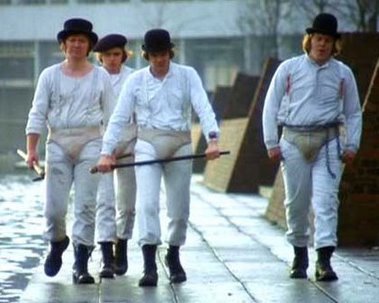
How the droogs look in A Clockwork Orange came about:

I was over at [Kubrick’s] house, you know, looking for stuff to do. And I didn’t like anything there, really. They had a big box of hats, some with feathers. I thought that was pretty lame. So I say, “Look, I’ve got my Cricket gear in my car.” So I went to the car and got my Cricket gear. And he says, “Oh yeah, I love the white.” And so I put it on. And he goes, “Oh put the protector on the outside.” And I went, “Great idea.” So I wore the protector on the outside like a codpiece. He goes, “This could be like the middle ages. I like this look.” And that’s how the look of the Droogs came; because I had my Cricket stuff in the back of my car.

via Malcolm McDowell and Leon Vitali Interview A CLOCKWORK ORANGE.

A Clockwork Orange

A Clockwork Orange