Deep Backward Point

Blog against the machine.

The Haydos Bot

The Old Batsman has spotted patient zero in the crictainment epidemic in Australia:

A virus has been imported, the Haydos hard drive has been wiped and replaced by a Trojan Horse. The mouth that once opened only to emit variations of the phrase ‘fuck off’ from first slip has been reprogrammed by a mid-90s management guru. He is now the proprietor of something called The Hayden Way.

‘As I encompass my core philosophies, it is with the creation of The Hayden Way…’ the Bot said. ‘we have been developing projects to engage people on a multitude of levels. Through branded media, bespoke events, community projects, education and activities that encourage everyone to enjoy the benefits of an active and healthy lifestyle.’
Riots? What Riots?

Jarrod makes the point that’s been on a lot of people’s minds– what would happen if these English riots were elsewhere in the world?

I’m not sure if that is a good thing or not, but if these riots were in the subbie, South Africa or the West Indies, I think if their boards released a presser saying that people were looking forward to the game so it will still go on, people might think that was a bit stupid, the ICC might poke their head around, and perhaps the other team might want to leave.

On the one hand, it’s always good to keep people honest by pointing out solid hypocrisy. There are clear double standards, even within the sub-continent.

On the other hand, these riots don’t hold a candle (or molotov cocktail) to the ones that bubble up in India once in a while. Just saying.

How to Win at Twenty20: A Statistical Analysis

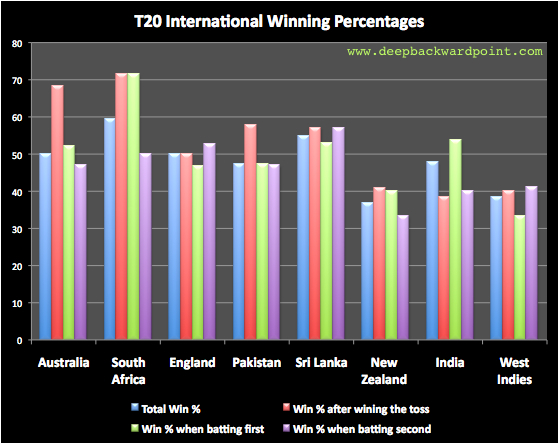
As Sri Lanka beat Australia twice batting first, I began to wonder if there was an inherent bias in T20 towards sides batting first, batting second or winning the toss.

So I ran the numbers in StatsGuru, and as always, things aren’t as simple as they seem.

Win % in Twenty20 Internationals

Win % in Twenty20 Internationals

The blue bars are total win percentage of the team. Red bars are win percentage after winning the toss. Green is when batting first, purple is when batting second. These statistics are only for these eight teams when they play each other.

A few things stand out like a sore thumb:

  • Australia do significantly better when they win the toss.
  • India do worse when the win the toss.
  • India like to bat first.
  • Sri Lanka doesn’t care– win the toss, lose the toss, bat first, bat second, their win percentage remains the same.
  • South Africa like to win the toss. And bat first.

Overall, sides batting first seem to have a slight advantage. This was not true in the IPL, at least anecdotally. I’d love to run the numbers for each IPL, to see how they differ and how they have changed over time.

Before India’s Awesome Fightback/Terrible Defeat

Alan Tyers writes an awesome choose-your-own-adventure style article on the state of the India-England series:

Off the pitch, however, a spat between [Voice of the New India / triumphalist buffoon] Ravi Shastri and [much-respected former England captain / bitter has-been] Nasser Hussain has further ignited simmering bad feeling. The DRS is just one battleground between the BCCI and the ECB as they fight over [the very soul of our great game / television money] and cricket adjusts to the [exciting / distressing] shift of power from Lord’s to Mumbai.

The Return of Zimbabwe

Former captain Taibu and current captain Taylor

Zim Braintrust: Taibu and Taylor

Meanwhile, in Harare-

Bangladesh and Zimbabwe are playing a full-blooded, evenly matched, positive game of Test cricket. Zimbabwe, playing their first Test match in a while, have made a sporting declaration towards the end of day four. Every single player in their side has justified their spot, and their captain has played to win.

That declaration at tea on day four was one that neither Strauss nor Dhoni would have made. Regardless of what happens on day five, Zimbabwe have made a solid announcement of their presence. Pakistan visit Zimbabwe later this month, and then Zimbabwe tour New Zealand in January. Their bowling seems up to the task.

Bangladesh have fought back more than once in the game. The straight-talking Tamim Iqbal said at the end of day four: “The wicket is flat so if we don’t make mistakes or do anything silly, we should win.” Which is a confident statement, considering they need 263 runs on the final day with 7 wickets in hand.

If ever there was an example of the spirit of cricket, it is not an English batsman being gifted a second chance because he lost his wicket on account of being stupid. The spirit of cricket is alive and well, at the Harare Sports Club.


Masakadza

Hamilton Masakadza scored a century on debut at the age of 17 against the West Indies. He had to wait another 10 years to get his second century. My player of the moment.

What the Spirit of Cricket is Not

I’ve mentioned this a few times before, but I’m not a big fan of the slippery slope of the “spirit of the game”. If you want to play the game that way, by all means, be my guest. My problem is when we start expecting it.

I could write more, but Andy Bull and Greg Baum have done a better job.

Bull:

It is permissible for a batsman to stand his ground if he knows he has touched the ball, but it is a sin for a fielder to claim a catch that has touched the ground. It is against the spirit to “dispute an umpire’s decision by word, action or gesture,” but the DRS now encourages players to do exactly that.

As the Guardian has proven, it is often easier to point out what the spirit of cricket is not than what it is.

Baum:

If the spirit of cricket is so sacred, some asked, why did not the close England fieldsmen recall Harbhajan? The answer is that there is no absolute standard, merely a set of conventions. It is acceptable, for instance, for a batsman to stand his ground when he knows for a fact that he is out, but abhorrent for a fieldsmen to claim a catch about which he is unsure. And that’s before we get to Vaseline.

What I wrote after India lost the first Test:

In professional sport, there is only one measure of “better”– it’s not who got more points, or got more yards, or carried themselves with more dignity, or who was “winning” for the majority of the game. Ironically, being “a good sport” usually means you’re losing.

My call– play tough, play by the rules and always play to win.

#BlameBCCI

I tried looking for a single quote to pull from this awesome Kartikeya Date article on the blame game in cricket, but I can’t. The whole thing is just too good. Go read.

As I alluded to at the end of my Trent Bridge song video, blaming BCCI without any additional legwork is the laziest trick in the book.

The Trent Bridge Test, in Song

As you know, I’m writing and performing a song about each Test in the India v. England series. Here is the one for the Lord’s Test. Without further ado, here is song two:

That’s a digital banjo and funk beats. And here are the lyrics (though I improvized to match the beat, so they are not precise):

Sreesanth and Ishant, having tea for two
Praveen joined in while the bounce was still true
By tea, they got England on a plate
How you gonna win a game from 120 for 8?

Hey Stewie Broad, you might not be aware
They call you Barbie on Twitter, that just don’t seem fair
‘Cause your batting like Beefy and bowling like him too
Though India’s chasing really well at 117 for two.

Hey Mr. Dravid, show a little rage
That you’re payin bills at your advanced age
VVS and Yuvraj tried to do their part
But that swinging ball from Stewie Broad was rippin’ it apart.

Let’s get that run out, out of the way
Bell was an idiot, to walk away
Dhoni held up the spirit of the game
Was he a sucker for Flower mind games.

Ian Bell batted on, and on and on
And on and on and on and on
India went on to promptly collapse
Maybe ’cause they wanted day 5 to relax

Hey Mr. Dhoni, what you gonna do?
You and your boys look like you haven’t got a clue
Tell you the truth, you don’t look like #1
Cause your team’s out there playing like it’s 1991

What Ganguly Said

A lot of people were #outraged by what Ganguly said. Apparently there are many things he said– about Dravid, about VVS, about Gavaskar, about Dhoni and about himself. I’m not going to list them here, you can Google them yourself.

Many people question why Ganguly had to say what he said. To those people, I’d like to say that Ganguly is now a paid cricket pundit. He makes his money by opining on cricket. This means his professional obligation is to the following:

  1. To comment on current events in cricket.
  2. When asked a specific question, he is obligated to answer.
  3. If he evades an answer, he becomes less employable as a pundit.
  4. Even worse, if he gives uninteresting answers over time, he becomes immensely less employable over time.

This is his career path. These are his responsibilities.