Deep Backward Point

Blog against the machine.

Tag: Cricket

The Sports Illustrated Fizzle

On 6th May, 2011, the story broke: Sports Illustrated India had a big match-fixing cover story. More than a month later, turns out what they had was either circumstantial, hearsay or just plain bunk.

Here’s their silly central conceit, in awesome pictorial form:
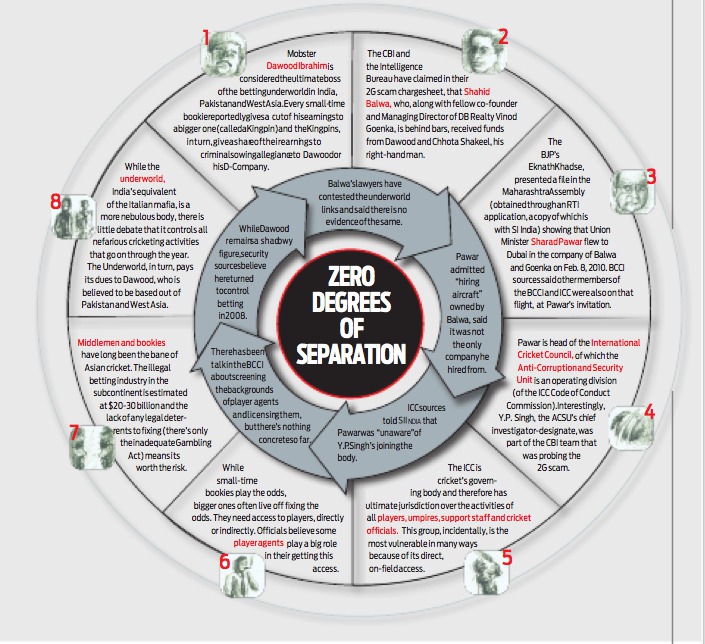
Sports Illustrated Plays Six Degrees of Kevin Bacon, Loses

Go on, and read the rest of the article. Actually, don’t. It is a terrible piece of journalism, as evidenced by the picture above. They either had no story, or had no one to back up the story they had. Either way, the story they ran with was this.

Bad people have been seen with other people who have been heard talking to these other people who may represent cricket players. Or not.

Also, what kind of magazine has no web site? For a brand like Sports Illustrated, with a story as “big” as the one they broke last month, to not have a web site is criminal. I could go on a rant like my epic Willow TV one, but I just don’t care about SI the way I care about Willow. So someone else will have to fight that battle.

I’ll just say that they need to hire a web developer. And real journalists.

Miandad as a Microcosm of Pakistan

Javed Miandad encompasses almost everything that makes Pakistan the most entertaining team of them all. Rob Bagchi and Rob Smyth recall one of the great innings of all time, where Miandad scored 200 not out of a total of 311:

Wickets continued to fall at the other end: 155 for five, 224 for six, 227 for seven. Then Javed added 43 for the eighth wicket with Robin Hobbs – who was out first ball. It was an astonishing partnership, with Javed facing every delivery for eight consecutive overs. His plan was simple: wait for the field to come up for the fifth delivery, hit over the top for a boundary, and then gleefully steal a single from the last ball. It was a delicious game of cat and mouse, except the mouse was terrorising the cat.

This innings on its own is a microcosm for Pakistani cricket. Including how the innings ended.

The Violent 400-year History of Hitting the Ball Twice

Facing the first ball after tea, Tilakaratne Dilshan almost played the ball on to his stumps, but avoided getting out by hitting the ball a second time, away from the stumps. Law #34 of the laws of cricket states that you can only hit the ball twice if you intend to protect your wicket. If you intend to score runs from the second hit, you’re out. Which sounds kind of counter-intuitive, but there’s a reason.

Turns out that cricket has a violent 400-year history that involves people getting killed because some idiot took the opportunity to hit the ball once to set up a second monster hit for six. From Wikipedia:

In 1622, several parishioners of Boxgrove, near Chichester in West Sussex, were prosecuted for playing cricket in a churchyard on Sunday 5 May. There were three reasons for the prosecution: one was that it contravened a local bye-law; another reflected concern about church windows which may or may not have been broken; the third was that “a little childe had like to have her braines beaten out with a cricket batt”! The latter situation was because the rules at the time allowed the batsman to hit the ball more than once and so fielding near the batsman was very hazardous[.]

Also:

In 1624, a fatality occurred at Horsted Keynes in East Sussex when a fielder called Jasper Vinall was struck on the head by the batsman, Edward Tye, who was trying to hit the ball a second time to avoid being caught. Mr Vinall is thus the earliest known cricketing fatality. The matter was recorded in a coroner’s court, which returned a verdict of misadventure.

In 1647, another fatality was recorded at Selsey, West Sussex, when a fielder called Henry Brand was hit on the head by a batsman trying to hit the ball a second time.

Jasper Vinall is officially known as the first man to be killed by cricket. To be a close in fielder in 17th century (East or West) Sussex was as good as a death warrant, it turns out.

In the case of Dilshan, there was an added twist to the tale. He was caught off his second hit and the fielder appealed. Of course, you can’t be caught out off the second hit. This is the kind of detail about cricket that makes me smile.

Think about it:

  • When Dilshan hit the ball the first time, he was almost out bowled.
  • He hit the ball a second time, and was not out.
  • But if he then set off for a run, showing intent to score off the second hit, he would be ruled out.
  • He was caught, but since it was off the second hit, he was not out.
And people wonder why I love cricket.

#ShankarFacts: The Secret Life of Adrian Shankar

A couple of days ago, I began a new Twitter hashtag, #ShankarFacts, to record the mythical, wondrous life of Adrian Shankar.

Who is Adrian Shankar, you ask? He’s a crafty young man who fooled two English counties about his age and background to get in to their teams.

So, taking inspiration from Chuck Norris Facts, here are the top #ShankarFacts that I created on Twitter so far:

  1. Adrian Shankar has batted at all eleven positions. In the same match.
  2. Adrian Shankar said WG Grace was the best batsman he ever played with.
  3. When Adrian Shankar bowls off spin, he has a doosra (2nd), teesra (3rd) and a unteesva (29th).
  4. Adrian Shankar fixes matches. He takes money to win.
  5. Sachin Tendulkar won the World Cup for Adrian Shankar. #forAdrian 
  6. Whichever end Adrian Shankar bowls from is called the Adrian Shankar End. 
  7. When Adrian Shankar bowls leg spin, he has an altavisty and a yahooey, in addition to his googley. 
  8. Adrian Shankar once hit 8 sixes in an over. 
  9. Adrian Shankar was the first wicketkeeper-bowler to captain a side.
  10. When Adrian Shankar hits the ball, it stays hit. #LikeATracerBullet
  11. Adrian Shankar’s wicket is equivalent to a collapse.
And my favorite one that was not written by me, from Howard Gadsby (@sir_velo on Twitter):
@AdrianShankar is a better sitar player than his uncle Ravi #ShankarFacts
And here’s the ultimate, true Adrian Shankar fact from his Lancashire team-mate, Luke Sutton:

Various rumours kept coming back that he was actually three years older than he stated. [He said] straight to my face without a shadow of doubt, was that he had been on a life support machine for the first three years of his life and was therefore physically three years younger than he should be. I challenged him on this and said that surely he grew during the three years on the life support machine. His simply replied ‘No I didn’t’ and walked off.

The iPad, the World Cup and a Baby: A Story of Cricket-Life Balance

This World Cup was unlike any other. I told part of the story at the end of yesterday’s BoredWaani podcast on experiences watching cricket in the US, but wanted to elaborate below.

Reason #1: The iPad
Willow TV streamed the games to all kinds of Internet-connected devices. I could switch from my iPad, to my iPhone to the Roku-connected TV and the game was on.

Reason #2: The Baby
My wife and I had a baby 5 months before the World Cup began. So the 5am starts weren’t an issue; one of the three of us was bound to be up at that hour.

But if you’ve ever had a baby, you know that you can’t deposit yourself in front of a television for a 7-hour game. You can’t deposit yourself in front of a television for T20. You can’t for more than 5 minutes until the baby is much older. I hear some people have to wait until their kid goes off to college. We’ll see.

So here we were: a cricket-loving couple with a 5-month old that was a higher priority than the World Cup. Sachin Tendulkar may be God, but his smile doesn’t make grown men weep. Just the way it is. His backfoot punch past the bowler, on the other hand…

This is where the iPad came in: we watched more cricket on the iPad than on the television. At 5am, without getting out of bed, we’d reach over to the iPad on the nightstand and flip it on. One ear bud in my wife’s ear, one in mine, drift in and out of sleep, sometimes with the baby sleeping between us.

As the day would begin: the baby’s playing in her room, Tendulkar’s playing on the iPad in a corner. We’re changing the baby, Ponting’s lying on the changing pad next to her. The baby goes to sleep, ear buds to hear Ravi Shastri.

Ubiquitous cricket. There’s nothing like it.

Reason #3: India won

Read the rest of this entry »

The Very Last Thing on Willow TV: a Boredwaani

I was invited to appear on a couple of episodes of the popular podcast Boredwaani on Bored Cricket Crazy Indians, the first of which is up on their site today.

In this episode, Samir Chopra, the Cricket Couch and I talk about our experiences with Willow TV both as past loyal customers as well as the more recent issues.

Thanks to Subash, Samir and Homer for making this happen.

The Fate of a Pakistan Captain

Returning to my obsession, here is the list of all Pakistan ODI captains since Imran (criteria: captained > 5 ODIs) with their fate. Forgive some oversimplification of facts in favor of brevity:

  1. Javed Miandad (’92-’93): Taken to the 1996 world cup to do nothing of note but break a world record, retired at the end of the WC and came out swinging against the administration.
  2. Saleem Malik (’92-’95): Banned for fixing
  3. Rameez Raja (’92-’97): Largely untarnished legacy
  4. Wasim Akram (’93-’00): Dumped in 2003, subsequently retired.
  5. Waqar Younis (’93-’03): Sacked after 2003 World Cup, subsequently retired. Only two years older than current captain, Misbah-ul-Haq.
  6. Moin Khan (’95-’01): Akmal’ed
  7. Saeed Anwar (’95-’00): Takes a break for his family, returns and then retires.
  8. Aamer Sohail (’96-’98): Match-fixing whistle-blower, suffers the consequences, retired in 2001.
  9. Rashid Latif (’98-’03): Serial whistle-blower, blew the whistle one time too many.
  10. Inzamam-ul-Haq (’02-’07): Post-2007 World Cup, quit the one day game. Left out of test side. Joined ICL.
  11. Mohammad Yusuf (’03-’10): Issues with the PCB, an ICL stint and finally a life ban.
  12. Younis Khan (’05-’09): Sudden resignation in 2006, reinstated later, resignation again. Banned by PCB in 2010.
  13. Shoaib Malik (’07-’09): Banned in 2010
  14. Shahid Afridi (’09-’11): Dropped unceremoniously from captaincy, followed by retirement until Butt’s resignation.
  15. Misbah-ul-Haq (’11-present): No controversies other than batting-speed. So far.
Previously on DeepBackwardPoint.com:

Classic Cricket: Boris Karloff Arguing with C. Aubrey Smith at a Cricket Game

I’m going to try to dig up classic cricket photographs, but here’s the first. I’m sure there’s a fantastic story behind this one– it’s Frankenstein aka Boris Karloff, arguing with C. Aubrey Smith at a cricket game. C. Aubrey Smith captained England for one Test match, before making his way to Hollywood, where he founded the Hollywood Cricket Club. They created a pitch with imported English grass and attracted fellow expats such as David Niven, Laurence Olivier, and Boris Karloff to the club as well as local American players. Which is where this argument likely occurred.

Life.com won’t let me embed the picture here, so click to see it.
(via Life.com)

Obama, Married to Cricket

Classic Zaltzman:

(If anyone remains in any doubt about Obama’s obsession with English Test cricket, he married a woman whose forenames are Michelle LaVaughn. Case closed.) (Admittedly, they were married in 1992, before the English, male Michelle LaVaughn had even made his debut for Yorkshire, but Obama is a man of vision, so let us assume he knew what was what in early 1990s youth cricket.) (Besides, the first lady’s maiden name was Robinson – meaning that the president has never married a woman whose passport was not bedecked with the name of a former England opening batsman.) (I digress.)

Conflict of Interest

Nitin Sundar, on the Indian Premier League finalé:

It all ended in ironic fashion as N Srinivasan, in his capacity as BCCI secretary, presented the winners medals to players of the Chennai Super Kings, the team he owns. Conflict of interest, anyone?