Deep Backward Point

Blog against the machine.

Category: Column

Korbo Lorbo Jeetbo

Today is a day for the Bengali.

My favorite non-Indian opener in the world was just named one of the four Wisden Cricketers of the Year. Tamim Iqbal, here’s hoping you play multiple 40 over ODI innings some day and the rest of your team doesn’t get bowled out before then.

The Bangladesh-Australia series begins tomorrow, and they couldn’t find the time for one Test match. Fifteen Australians fly all the way to Bangladesh for only three days of international cricket? A shame.

For those of you in the US, ESPN3 will stream that series live.

Finally, the IPL. The game is about to begin, and Kolkatta is my favorite team.

The IPL is a “cult of personality” event, and so I’ll stick with the players that excite me the most for now. KKR has:

  • Eoin Morgan
  • Shakib al Hasan
  • Ryan ten Doeschate
  • Yusuf Pathan

That’s all I need.

Ryan ten Doeschate

Ryan ten Doeschate's century against England almost got the Netherlands the first upset of the tournament

The History of One Day Cricket: Part I

The One Day International has changed dramatically in its 40 years of existence. Here is part one of my analysis of the game:

Highest Score per team, per year

We’ve come a long way since the ’70s. It used to be a 60-over innings and teams barely got a couple of hundred runs. In 1977, no team made more than 250 in their allotted 60 overs. Every year since 2004, the top eight teams have had a 300+ score every year. We’ve come a long way, baby.

Take a look at how Jayasuriya and company changed the game in 1996. It’s an outlier, so different from the years around it and wouldn’t be surpassed until the batting powerplay was instituted in 2006.

Highest Score of World Cup 2011: 375 by India against Bangladesh

High Scores in One Day History

High Scores in One Day History (click for larger version)

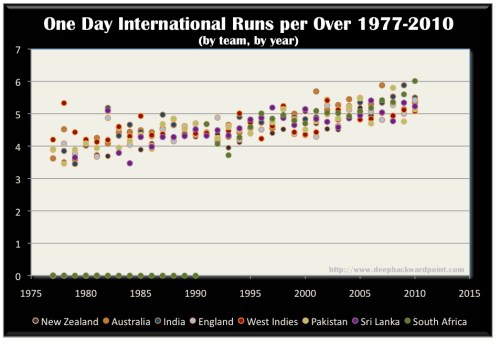
Runs per over per team, per year

We’ve gone from a par average of 4 to a par average of 5.5. In 1994, every team had a yearly run rate of 5 and under. By 2010, every team was over 5. In fact, South Africa finished 2010 at 6 runs per over for the year.

Top 8 Teams Run Rate at World Cup 2011: 5.38

Run Rate by Year in One Day History

Run Rate by Year in One Day History (click for larger version)

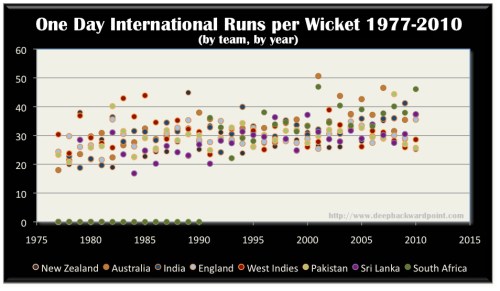
Runs per wicket per team, per year

Now here’s something that hasn’t changed much as the game has changed. Even though teams are scoring at a (much) faster pace, the runs per wicket has been largely steady. Barring some outliers (West Indies in the early days, Australia in the last 10 years), the average has barely increased from the upper 20’s to the low 30’s.

In both this chart and the runs per over, Sri Lanka’s progress between say 1983 and 1996 has been the most dramatic. On this chart, Sri Lanka goes from about 18 in 1984 to 38 in 1997. Of note: Australia crossed 50 runs per wicket in 2001.

Also, look how the mighty have fallen. West Indies dominates every chart here for the first decade and then drops off the map. Finally, the era of Aussie dominance ended in 2008- the orange dot on all three charts falls from the top that year.

World Cup 2011: Matches Among Top 8 Teams:
Side Batting First: 29.58 Runs per Wicket
Side Batting Second: 31.61 Runs per Wicket
Overall: 30.49

Average per wicket per year in One Day History

Average per wicket per year in One Day History (click for larger version)

In the next installment, I will present three charts on how the balance of power in one day internationals has changed over 40 years.

Notes:

  • Only the top eight teams (no Zimbabwe, no Bangladesh) have been considered.
  • The runs per over are for the entire year, with each dot representing a different team.
  • The runs per wicket are for the entire year, with each dot representing a different team.
  • The highest score is the highest score for a particular team in that year.
  • The color code for each country is consistent across all charts.
  • Statistics until the end of 2010 are reflected in the charts.

Tendulkar Pulls an Obi Wan Kenobi

In the original Star Wars from 1977, Obi Wan Kenobi is the wise old sage trying to mold young Luke Skywalker, the titular new hope, in to the Jedi who will save the galaxy.

It was too hard for Skywalker to understand a war on a galactic scale, or how he could win it:

It’s not that I like the Empire; I hate it, but there’s nothing I can do about it right now. It’s all such a long way from here.

Luke watched Obi Wan sacrifice his life in a lightsaber battle with Darth Vader. This made the war personal– from that point on Luke was fighting to avenge Kenobi. He would win it for Kenobi. As Kenobi prepared to give his life, he told Vader:

You can’t win, Darth. If you strike me down, I shall become more powerful than you could possibly imagine.

Obi-Wan-and-Vader

If you strike me down, I shall become more powerful than you could possibly imagine.


One can imagine Tendulkar saying the same thing to Sanga and Malinga as he lost his wicket at the top of the innings. At that moment, even though he didn’t intend it, Tendulkar gave the rest of the team a reason to win it. They had said that they would do it for Tendulkar. Now they had to prove it. Tendulkar wasn’t going to do it for them.

By not holding their hand across the victory line, Tendulkar effectively ushered in the next generation of Indian cricket.

With a quote that will be repeated for a million years, Kohli effectively stated the same:

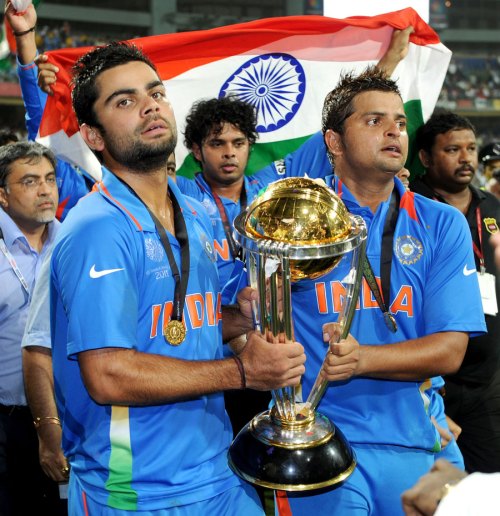
Tendulkar has carried the burden of the nation for 21 years. It is time we carried him on our shoulders.

Kohli and Raina

Kohli and Raina were in diapers when Tendulkar made his debut

The Most Entertaining World Cup of All Time

I think this has been the most entertaining World Cup of them all, and not just because my team won. Even before the semi-finals, the entertainment quotient had far superseded anything in my cricket-watching life (~1986 – present).

It has only been four short years since the worst World Cup of them all– 2007. Between lackluster group stages, allegedly murdered coaches, and the tragedy of bureaucratic errors in the final, 2007 was so bad that Subhash Chandra of Essel Group wrote and paid for the obituary of the one day format when he hatched his plans for the Indian Cricket League. The BCCI soon wrote their obituary for the nascent ICL, and the Indian Premier League was born.

And now, we have had the best World Cup of all time– brought to us by the same bungling ICC, in spite of a largely unchanged format. The question is: what made this World Cup so special and how can we make sure this happens again?
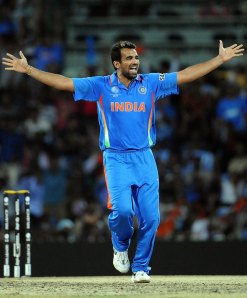
Zaheer

Zaheer Khan

A Bowler’s World Cup

In every match, barring India v. Bangladesh, the bowlers had a significant role to play. Far from killing bowling, the Twenty20 format has fostered variation in bowling and captaincy around bowling. Couple that with the batting disaster known as the batting powerplay, and you have a World Cup where bowlers always fancied their chances.

Here are the statistics for matches between the top 8 teams:

  • Average first innings score: 241
  • Average first innings wickets lost: 8.77
  • Average second innings score: 219
  • Average second innings wickets lost: 6.66

In 10 out of 18 such matches, the side batting first was all out. But these are just raw statistics– if you look at the results of these 18 games, with a subjective reading, more than half were bowling victories. Even in the outright batsmen-centric matches, it was the bowlers that made things interesting:

Throw in the inability to tackle the batting powerplay (which has been analyzed to death) and some smart captaincy around spinners and the second new 34th over new ball, and the batsmen were never allowed to run away with most of the top-tier games.

India’s world-beating batting line-up never won because they batted the opposition out of the match (except against Bangladesh). They won because they batted deep, and when a couple of them failed the rest picked up the slack.

Kevin O'Brien

O'Brien's 50-ball century helped Ireland chase a mammoth 327 against England

Playing Above Their Pay Grade

A second reason for the quality of the World Cup was Bangladesh and Ireland performing well above their pay grade. By beating England and remaining competitive in a couple of other matches, they kept Group B interesting until the end. Also, New Zealand played a little above their pay grade in the knock outs to offer just enough spice outside the India v. Pakistan semi-final.

The month-long group stages seemed destined for drabness. Thanks to Bangladesh, Ireland and one other team (below), that month was great fun. They proved me wrong, and I’m happy.

Playing Below Their Pay Grade

The one other team– England. England played only one dull match and that was the match that knocked them out in the quarter-finals. But until then, they played every match exactly opposite to expectations, kept sending players home from injury and generally contributed to an exciting group stage. If only they played to potential, it would have been a more interesting knock-out stage. But somebody’s got to play the part of the jester.

The Fall From Grace

Finally, Australia are no longer as good as they once were. This opened up the field so that everyone considered themselves a contender. India seemed the anointed successors, but few were certain they had it in them until it actually happened. As the quarter-finals began, every single team may have thought they were in with a chance. This is a far cry from the last three World Cups.

So, how do we make sure this happens again? I’m not sure, but here are some thoughts that can’t hurt:

  1. Nurture the domestic and Twenty20 game in Ireland, Bangladesh and the Netherlands to grow the game to at least 12 teams
  2. While we’re at it, nurture the domestic game in West Indies and New Zealand so that the game doesn’t shrink to 6 teams
  3. Think long and hard about introducing a new bowler-friendly rule

In addition, I think fewer meaningless one day series between World Cups and more cricket between India and Pakistan is a good thing.

I still don’t think this format for the World Cup is ideal– the ICC got lucky with Bangladesh, Ireland and England playing the way they did. The only way they will get lucky again is if there are more than eight good teams in the world.

Why I Love/Hate India v. Pakistan

Hate.
  1. Jingoism masked as patriotism.
  2. Religious hatred masked as sporting rivalry.
  3. Patriotism masked as a love of sport.
  4. The poisonous “Zaheer Khan miyo chhe etle full toss naakhyo” (translated: “Zaheer Khan is Muslim, that’s why he bowled a full toss.”) I wonder if they say the same about Kaneria on the other side.
  5. If they win, Kashmir.
  6. If they lose, allege match-fixing, commence stone-throwing, effigy-burning.

In short, it’s just not cricket.

At the end of the guard changing ceremony at t...

Image via Wikipedia

Love.

  1. Javed Miandad’s last ball six off Chetan Sharma.
  2. Anil Kumble’s 10 wickets in an innings.
  3. Aamer Sohail bowled Venkatesh Prasad.
  4. Ajay Jadeja’s quick-fire 45.
  5. A 19 year-old Tendulkar and 33 year-old Kapil Dev on fire in Sydney.
  6. Aaqib Javed’s hat-trick of LBWs.

Ok, strike that last one. I hate that.

The First Among Equals

On paper, India is the best of the remaining teams in the World Cup. But on paper strength has never meant much. On paper, India should score 350+ every match. On paper, South Africa should have made the finals of every World Cup since ’92.

Not much separates the top eight teams in the world, mainly because the good teams are inconsistent and the average teams are tenacious. It’s a time of great turmoil, as many teams rush to replace Australia at the top of the world.

In such a tournament, there is no favorite. As the semi-finals are about to begin, there is no obvious choice. This is new territory– Australia have been favorites to win for over a decade now.

In such a tournament, the winner deserves to be the winner by virtue of having won. That is to say, if a team manages to win three knockout games in a row against top-8 opposition, they deserve to be crowned world champions.
20110328-102230.jpg
The act of winning the World Cup will be the only thing that differentiates one of the remaining teams. And that is the characteristic of a great tournament.

Gallery: England’s Unlikely Nemeses

Four unlikely heroes who have put England on the verge of elimination from the World Cup:

Ryan ten Doeschate

Ryan ten Doeschate's century against England almost got the Netherlands the first upset of the tournament

Kevin O'Brien

O'Brien's 50-ball century helped Ireland chase a mammoth 327 against England

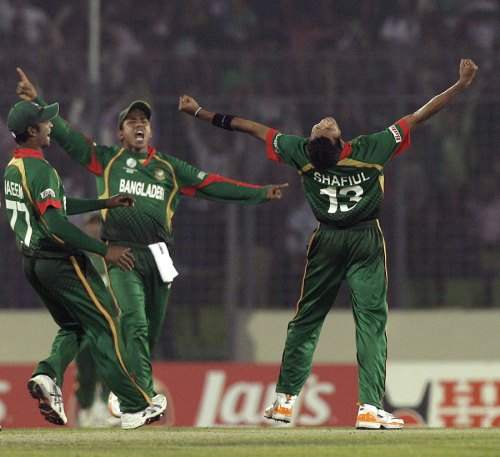
Shafiul Islam

Shafiul Islam followed his 4 wickets against Ireland with a phenomenal finish against England

Mahmudullah

Mahmudullah held his nerve with Shafiul to get over the line against England

England: Producing Excitement Through Mediocrity

There have been two good and two great cricket matches in the World Cup so far:

  1. England v. Netherlands: Netherlands bats first, scores 292 on the back of a ten Doeschate blinder and England falter a bit before winning.
  2. Sri Lanka v Pakistan: Sri Lanka fail to chase a total within their reach against a never-say-die Pakistan bowling attack.
  3. England v. India: India bat England out of the game. Then England almost walk away with it. Zaheer brings India right back. And it’s a tie.
  4. England v. Ireland: England bat Ireland out of the game. Ireland collapses, before Kevin O’Brien walks away with it.

Do you sense a pattern? England was involved in three of the four games. They’ve produced exciting matches by vastly under-performing.

On the other hand, two teams produced excitement by over-performing: Ireland and Pakistan.

In fact, Pakistan and England have had diametrically opposite performances in the World Cup so far.

England: Top order fires, middle-order misfires and bowlers don’t show up to work.

Pakistan: Top order fails, middle-order rescues and bowlers save the day.

Everything That’s Wrong With World Cup Cricket

Shaun of the Dead

A clean shot to the head may be just what this tournament needs.

The big point everyone seems to be making this week is that the terrific India v. England match last weekend was an excellent advertisement for the sport, brought the tournament alive and proved that One Day cricket is alive and well.

Quite the opposite.

The India v. England match was the exception that proved the rule. It reminded us of how good a One Day match could be, but almost always isn’t.

We have now been through fourteen matches at the World Cup, of which only two have been good-ish and one has been great. That is an abysmal ratio. The India v. England match was the one great day in the first two weeks of the tournament. And that one day won’t even affect who makes it to the quarter-finals.

The next five matches are not very promising either: England v. Ireland, Netherlands v. South Africa, Canada v. Pakistan, Bangladesh v. West Indies.

Maybe we’ll get five more hat-tricks. That will be an excellent advertisement for the sport and bring the tournament to life.

And surely One Day cricket is alive and well.

Until the IPL begins next month.

This is a tournament where the organizers have gone out of their way to make sure that all but one of India’s group matches are on the weekend. Let that sink in for a minute.

The only reason India’s match against the Netherlands is not on a weekend is that the tournament group stage spans five weekends, and India play six matches.

The two good-ish matches I cited above were the Netherlands v. England and Sri Lanka v. Pakistan.

The Case Against Minnows in the One Day World Cup

Number ten

Ryan Ten Doeschate of The Netherlands (by imogenhardy via Flickr)

Haroon Lorgat, the Chief Executive of the ICC, on keeping the Associate member teams out of the next world cup:

“The 50-over format is more skill-based and suitable for the top teams.”

His argument is that Twenty20 is less skill-based, and so a better format for the less skill-based teams.

This is precisely the argument used to keep Sri Lanka out of Test cricket thirty years ago. I can imagine someone saying then: “Test cricket is a more skill-based format.”

Twenty20 is a better ambassador for the game. It’s a shorter format, faster paced, easier for the casual viewer and an easier sell to a world that is used to watching a game after work and having a result by dinner.

If a Twenty20 match is as one-sided as the Sri Lanka v. Canada game last week, at least it’s over much sooner. And there’s a better chance that a single inspired batting performance can even the scales. Ryan Ten Doeschate is an exciting player when chasing 200 in 20 overs, but is a tragic figure when surrounded by the rest of the Netherlands team for 50.

Lorgat’s point is trite, elitist and careless. Skill has nothing to do with it.

If, after all this, the only time Canada get to play a top team is every four years at a Twenty20 World Cup, then nothing has changed. A refocus to Twenty20 as the ambassador is acceptable only if it’s coupled with a clear path for promising teams like Afghanistan and Ireland to graduate to the big leagues.

Ordered by Lorgat’s mythical skill levels, we currently have six top teams, two close seconds (NZ, WI), two also rans (Zimbabwe, Bangladesh) and then a vast gulf before we get to the rest of the associates.

If the one-day World Cup pool is to be reduced, the single-minded focus of the ICC (besides making money for the BCCI) should be on closing that gulf.