Deep Backward Point

Blog against the machine.

Category: Column

The Pakistani Fountain of Youth in Numbers: a Chart on Catching Talent Young

Recently Jarod Kimber was gushing over the new Pakistan quick Junaid Khan. In doing so, he said that in addition to flair and skill, it is the youth of new Pakistan bowlers that makes them so appealing. Of course, I’m paraphrasing. Jarrod never says anything so dull.

This got me thinking about how early Pakistan cricketers start in International cricket. Anecdotally, it seemed Pakistan had the most young debutants. This led me to StatsGuru. Which led to this chart (click the chart for an awesome large version)– the bars represent % of total debutants who were under 22, and there’s one bar per decade, per team:

Debuts Under Age 22 (as % of Total Debuts)

Debuts Under Age 22 (as % of Total Debuts) by Decade in ODI cricket

(View Enlarged)

I started by just getting the per team numbers for all 40 years of ODI cricket. This was great, and demonstrated the same trend (younger debuts in the sub-continent, older in England/Aus), but I wanted to see how these numbers changed over time. So I pulled the numbers separately for each decade of One Day cricket.

A few points that stand out for me:

  • Pakistan and Sri Lanka have consistently favored youth. The remarkable thing is that their numbers remain high regardless of the fortunes of their team.
  • English players have historically taken time to prove themselves worthy of an international cap, until the last decade. Perhaps this is a reason for their recent success?
  • West Indies has oscillated dramatically between starting older and starting young.
  • Do teams turn to youth when they are struggling? This is obviously the case with Bangladesh and Zimbabwe– I didn’t include their data here– but how about other teams? What I was trying to get at by splitting the data in to four decades.
  • In countries like England, there is actually something going on at the other end of the spectrum. Andrew Strauss was effectively forced out of the side at age 34. A combination of the under-22 and over-34 problem is why the total centuries by the entire current English Test side is less than Tendulkar+Dravid*.
  • Finally, it doesn’t help to compare 1970’s statistics to other decades. It was the first decade of ODI cricket, and most “debuts” were actually established players. It does make sense, however, to compare 1970’s numbers between teams. Even in that early decade, Pakistan is substantially ahead of the rest.
Starting players late means they have shorter shelf-lives. Not only that, it makes for poorer branding. The reason adjectives like exciting get thrown around a lot more for Pakistani bowlers and Indian batsmen is because at 19 they’re blowing top-notch opposition out of the water.

I also pulled overall (40 year) numbers for Bangladesh and Zimbabwe, but I don’t consider them interesting. They have such a poor record that they have no choice but to turn to the teenagers. If you’re interested, Bangladesh is 66% under 22 debuts, and Zimbabwe is 51%.

* And talent, of course.

Feeding the Trolls in the Cricinfo Comments: Part I

Here is Part 1 of my attempts to feed the trolls in the Cricinfo comments. [part 2]

On Samir Chopra’s inaugural blog post on his new blog The Pitch, Geoff Plumridge comments (UPDATE: it gets better, Mr. Plumridge responds in the comments below too):

The ashes as a pinacle is no myth mate. You other johnny come latelys can only dream of heritage like that. When Billy Midwinter bowled Australia to victory most Indians had never heard of cricket. WE built this international game and the rest of you people only rode on our coat-tails. Remember your place in the history of the game.

Dear Geoff Plumridge,

Thank you for the coattails. To demonstrate their gratitude, the BCCI will allow you to ride their coattails until 2015. In memory of your place in the history of the game, the BCCI will create a museum exhibit honoring you next to the Aztec, Lost City of Atlantis, Titanic and dinosaur exhibits.

Thank you,
Devanshu Mehta

P.S. The Indians had beaten England in an away game around the same time as Billy Midwinter. Have you not heard of the extraordinary late-19th century team of Bhuvan, Mukhiya, Kachra and Lakha?

In Which We Visualize the Awesomeness of Dravid (and Tendulkar) in a Single Chart

Dravid played a Dravid-esque inning yesterday, and in his honor, I present a single chart to show you his awesomeness.

And Sachin Tendulkar’s even more awesomeness.

# of Centuries in Test Cricket

In which we demonstrate the awesomeness of Dravid, but mostly Tendulkar, in a single chart

Why India Needs a Players Association

Over at Cricinfo today, Osman Samiuddin makes the case for a Pakistan cricket players association:

There has never been a greater need for one than now. Shahid Afridi’s needless legal battle with the board is only the latest in a burgeoning collection. Shoaib Akhtar’s fight with Nasim Ashraf, the former chairman, went to the Lahore High Court in 2008. Pakistan’s ICL players took the PCB to the Sindh High court as well. These will not be the end.

I would argue that India needs one as well. The current Sri Lankan Premier League dispute is a perfect case. The BCCI has barred Indian players from appearing in the SLPL, saying that the players may find themselves in a bad contract with a private organization with no recourse. This is the kind of dispute a players association should handle. Players must get advice from a body that represents the players. Not the sponsors, or the team owners, or politicians, or hidden agendas, but the players.

This is largely a conflict of interest issue. What is the mandate of the BCCI? The BCCI has multiple interests to look out for– players, broadcasters, “cricket”, sponsors, politicians, money, state associations. So what happens when two or more of these interests are in opposition?

So far, the BCCI has walked a tight-rope quite well. It’s especially difficult when you can simultaneously run the risk of angering Maharashtra supremo Sharad Pawar, and god-to-billions Sachin Tendulkar, and some of the richest men in the country in Ambani and Mallya. Keeping all these interests straight is difficult, if not impossible.

And sooner or later, I predict, there will be a breaking point. Already the injuries to Sehwag and Gambhir, aggravated through the IPL, have brought up significant conflict of interest issues. The ICL was another issue where players could have used collective bargaining and better advice.

India has a players association. Or at least had one. It was launched with much fanfare in 2002, Arun Lal was its secretary and Dravid was pushing for its recognition as late as 2008. Anyone know what became of the Indian Professional Cricketers Association?

Dysfunction Junction: The Sri Lankan Edition

These days, it’s hard to figure out which cricket establishment is the most dysfunctional.

Behind door #1, we have Pakistan, stuck in a perpetual retire-ban-fix-rinse-repeat cycle. Behind door #2, we have West Indies, who keep their best batsman out of the team out of pure spite. Behind a newly emerging door #3, we have Cricket Australia, who were taken by surprise when a feisty Simon Katich pulled an Afridi by taking them on publicly.

Hashan Tilakaratne

Hashan Tilakaratne of the United National Party, not to be confused with the United People's Free Alliance

But today, I want to talk about door #4: Sri Lanka. Let me connect the dots in this strange political brew.

  1. Hashan Tilakaratne has accused Sanath Jayasuriya and Aravinda de Silva of match-fixing.
  2. Sanath Jayasuriya has been recalled to the ODI squad at the age of 41.9, only to announce that he will retire after the first game.
  3. Upul Tharanga has been kept out of the team, after testing positive for banned substances.
  4. Arjuna Ranatunga claims that the doctor who prescribed the banned substance to Tharanga is also the Sri Lankan president’s personal physician, Eliyantha White.
  5. Eliyantha White’s medical credentials are “not known“.
  6. Sri Lankan president, Mahinda Rajapaksa, belongs to the United People’s Freedom Alliance.
  7. Sanath Jayasuriya is a Member of Parliament from the same party.
  8. Arjuna Ranatunga is a Member of Parliament from Democratic National Alliance.
  9. Hashan Tilakaratne is a Member of Parliament from United National Party.
  10. All three of them are in separate parliamentary alliances, as far as I can tell.
It’s all very Monty Python.

The Pattern of Indian ODI Chases in 2011

As I watched India (barely) successfully chase 225 with 3 wickets to spare against West Indies on Saturday, it seemed that a pattern had emerged. This match resembled many Indian chases in recent times, where it would appear the batting line-up failed, but it would still be a successful chase because they bat so deep.

So I went over their recent record in seven consecutive successful chases since the World Cup began:

  1. India v. Ireland (World Cup): Ireland scored 207 batting first. India’s chase seemed to falter, wickets fell regularly (100 for 4), but runs kept coming as India won with 4 overs and 5 wickets to spare. (scoreboard)
  2. India v. the Netherlands (World Cup): The Netherlands scored 189 batting first. India’s chase again seemed to falter, wickets fell regularly (139 for 5), but they won by 5 wickets with 13.3. overs to spare. (scoreboard)
  3. India v. Australia (World Cup): In the quarter-finals, Australia scored 260 batting first. India’s lost wickets regularly (167 for 5), but kept the scoring rate up and ultimately chased it down with 5 wickets and 3 overs to spare. (scoreboard)
  4. India v. Sri Lanka (World Cup): In the finals, Sri Lanka scored 274 batting first. India lost their openers cheaply, but kept the scoring rate up to win by 6 wickets with 10 balls to spare. (scoreboard)
  5. India v. West Indies, 1st ODI: West Indies score 214 batting first. India lose wickets regularly, but bat deep to chase it down with 4 wickets and 3 overs to spare. (scoreboard)
  6. India v. West Indies, 2nd ODI: This one doesn’t fit the mold. West Indies score 240, and in a rain-shortened match, Virat Kohli and Parthiv Patel make it look easy, winning with 7 wickets to spare. (scoreboard)
  7. India v. West Indies, 3rd ODI: Chasing 225, India lose wickets in a heap (92 for 6), but Rohit Sharma, Harbhajan Singh and some late hitting by Praveen Kumar rescue them. India wins by 3 wickets with 3.4 overs to spare. (scoreboard)
A few obvious notes to make:
  • None of these chases would have been possible without great bowling upfront to restrict the opposition.
  • India bats very, very deep.
  • The key seems to be that even as wickets fell, the scoring rate didn’t drop in these games. The asking rate was never too imposing for the new batsmen.
  • This style of chasing seems inspired by T20. Many short quick innings, instead of a couple of long, deliberate ones.
  • I started the list after the South Africa series. India chased poorly against South Africa.

The Sports Illustrated Fizzle

On 6th May, 2011, the story broke: Sports Illustrated India had a big match-fixing cover story. More than a month later, turns out what they had was either circumstantial, hearsay or just plain bunk.

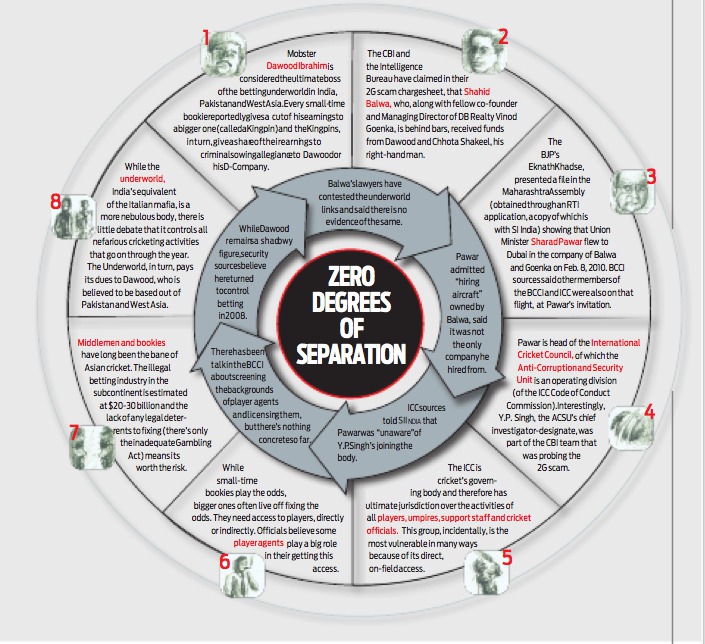
Here’s their silly central conceit, in awesome pictorial form:

Sports Illustrated Plays Six Degrees of Kevin Bacon, Loses

Go on, and read the rest of the article. Actually, don’t. It is a terrible piece of journalism, as evidenced by the picture above. They either had no story, or had no one to back up the story they had. Either way, the story they ran with was this.

Bad people have been seen with other people who have been heard talking to these other people who may represent cricket players. Or not.

Also, what kind of magazine has no web site? For a brand like Sports Illustrated, with a story as “big” as the one they broke last month, to not have a web site is criminal. I could go on a rant like my epic Willow TV one, but I just don’t care about SI the way I care about Willow. So someone else will have to fight that battle.

I’ll just say that they need to hire a web developer. And real journalists.

#ShankarFacts: The Secret Life of Adrian Shankar

A couple of days ago, I began a new Twitter hashtag, #ShankarFacts, to record the mythical, wondrous life of Adrian Shankar.

Who is Adrian Shankar, you ask? He’s a crafty young man who fooled two English counties about his age and background to get in to their teams.

So, taking inspiration from Chuck Norris Facts, here are the top #ShankarFacts that I created on Twitter so far:

  1. Adrian Shankar has batted at all eleven positions. In the same match.
  2. Adrian Shankar said WG Grace was the best batsman he ever played with.
  3. When Adrian Shankar bowls off spin, he has a doosra (2nd), teesra (3rd) and a unteesva (29th).
  4. Adrian Shankar fixes matches. He takes money to win.
  5. Sachin Tendulkar won the World Cup for Adrian Shankar. #forAdrian 
  6. Whichever end Adrian Shankar bowls from is called the Adrian Shankar End. 
  7. When Adrian Shankar bowls leg spin, he has an altavisty and a yahooey, in addition to his googley. 
  8. Adrian Shankar once hit 8 sixes in an over. 
  9. Adrian Shankar was the first wicketkeeper-bowler to captain a side.
  10. When Adrian Shankar hits the ball, it stays hit. #LikeATracerBullet
  11. Adrian Shankar’s wicket is equivalent to a collapse.
And my favorite one that was not written by me, from Howard Gadsby (@sir_velo on Twitter):
@AdrianShankar is a better sitar player than his uncle Ravi #ShankarFacts
And here’s the ultimate, true Adrian Shankar fact from his Lancashire team-mate, Luke Sutton:

Various rumours kept coming back that he was actually three years older than he stated. [He said] straight to my face without a shadow of doubt, was that he had been on a life support machine for the first three years of his life and was therefore physically three years younger than he should be. I challenged him on this and said that surely he grew during the three years on the life support machine. His simply replied ‘No I didn’t’ and walked off.

The iPad, the World Cup and a Baby: A Story of Cricket-Life Balance

This World Cup was unlike any other. I told part of the story at the end of yesterday’s BoredWaani podcast on experiences watching cricket in the US, but wanted to elaborate below.

Reason #1: The iPad
Willow TV streamed the games to all kinds of Internet-connected devices. I could switch from my iPad, to my iPhone to the Roku-connected TV and the game was on.

Reason #2: The Baby
My wife and I had a baby 5 months before the World Cup began. So the 5am starts weren’t an issue; one of the three of us was bound to be up at that hour.

But if you’ve ever had a baby, you know that you can’t deposit yourself in front of a television for a 7-hour game. You can’t deposit yourself in front of a television for T20. You can’t for more than 5 minutes until the baby is much older. I hear some people have to wait until their kid goes off to college. We’ll see.

So here we were: a cricket-loving couple with a 5-month old that was a higher priority than the World Cup. Sachin Tendulkar may be God, but his smile doesn’t make grown men weep. Just the way it is. His backfoot punch past the bowler, on the other hand…

This is where the iPad came in: we watched more cricket on the iPad than on the television. At 5am, without getting out of bed, we’d reach over to the iPad on the nightstand and flip it on. One ear bud in my wife’s ear, one in mine, drift in and out of sleep, sometimes with the baby sleeping between us.

As the day would begin: the baby’s playing in her room, Tendulkar’s playing on the iPad in a corner. We’re changing the baby, Ponting’s lying on the changing pad next to her. The baby goes to sleep, ear buds to hear Ravi Shastri.

Ubiquitous cricket. There’s nothing like it.

Reason #3: India won

Read the rest of this entry »

The Very Last Thing on Willow TV: a Boredwaani

I was invited to appear on a couple of episodes of the popular podcast Boredwaani on Bored Cricket Crazy Indians, the first of which is up on their site today.

In this episode, Samir Chopra, the Cricket Couch and I talk about our experiences with Willow TV both as past loyal customers as well as the more recent issues.

Thanks to Subash, Samir and Homer for making this happen.